The pieces up to this point, covered separately, told the story of PING's putters. This one moves to an iron.
The PING Eye2 is widely cited as the best-selling iron set in history.
The core technology in this club later triggered litigation with a rules body — that story is covered separately. Here, we look at what the club itself was.
1. 1982 — taking over the market
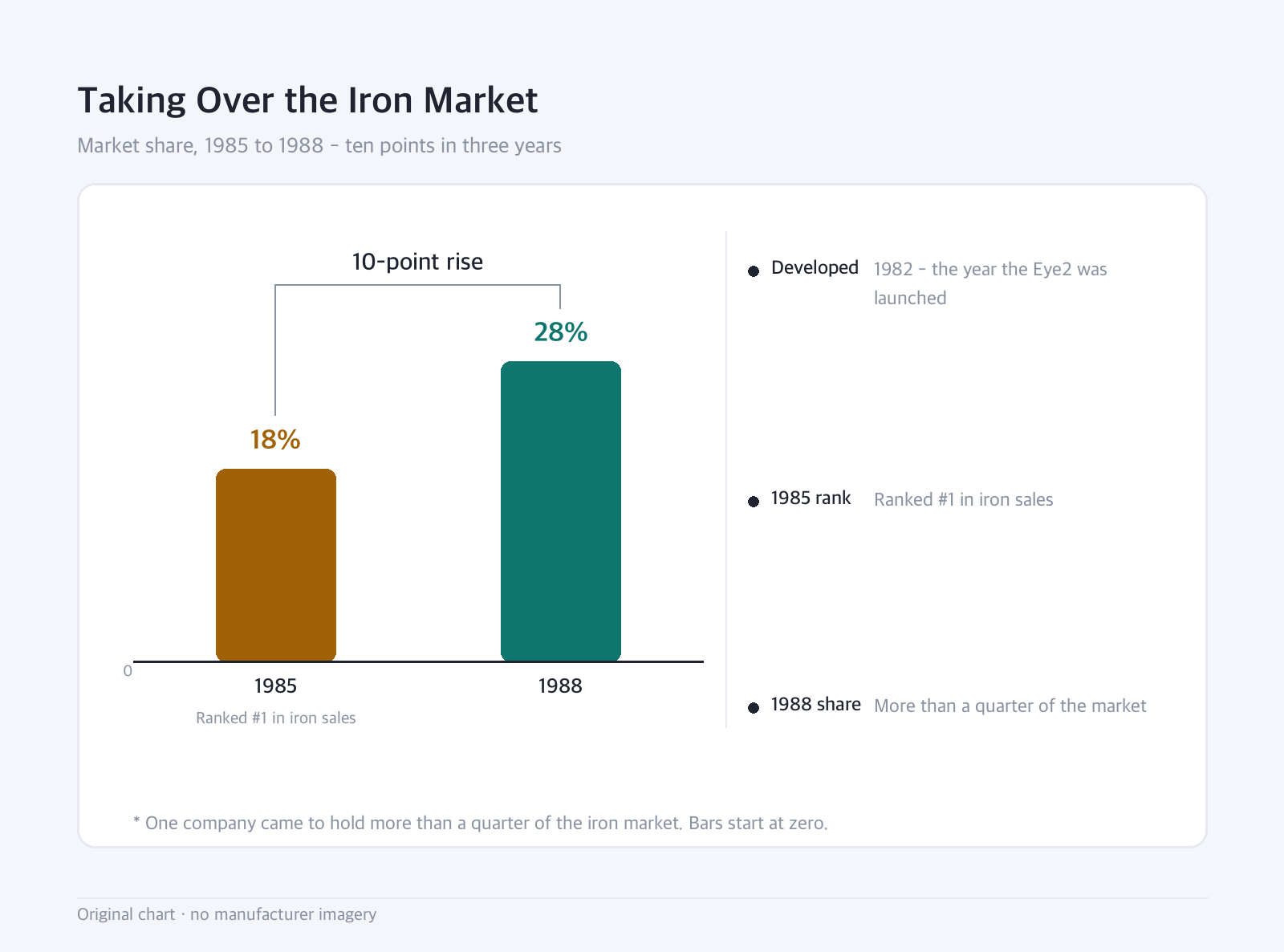
The Eye2 was developed in 1982.
The market response shows up in the numbers:
- 1985 — 18% market share, ranked #1 in iron sales
- 1988 — 28%
Ten percentage points in three years. One company came to hold more than a quarter of the iron market.
This was a company that had started in a garage roughly two decades earlier.
2. What was different — perimeter weighting
The core idea is the same one covered in the earlier pieces on PING's putters: perimeter weighting.
Karsten Solheim's original insight was this: put weight around the perimeter, and the head twists less on an off-center hit.
An idea that started with a putter in 1959 was applied to irons here. The back of the head was hollowed out and that weight sent to the toe and heel.
The result was a larger sweet spot. Ball speed and direction held up better on mishits.
Most cavity-back irons on the market today, including ones covered separately, use this approach.
3. Aerospace materials
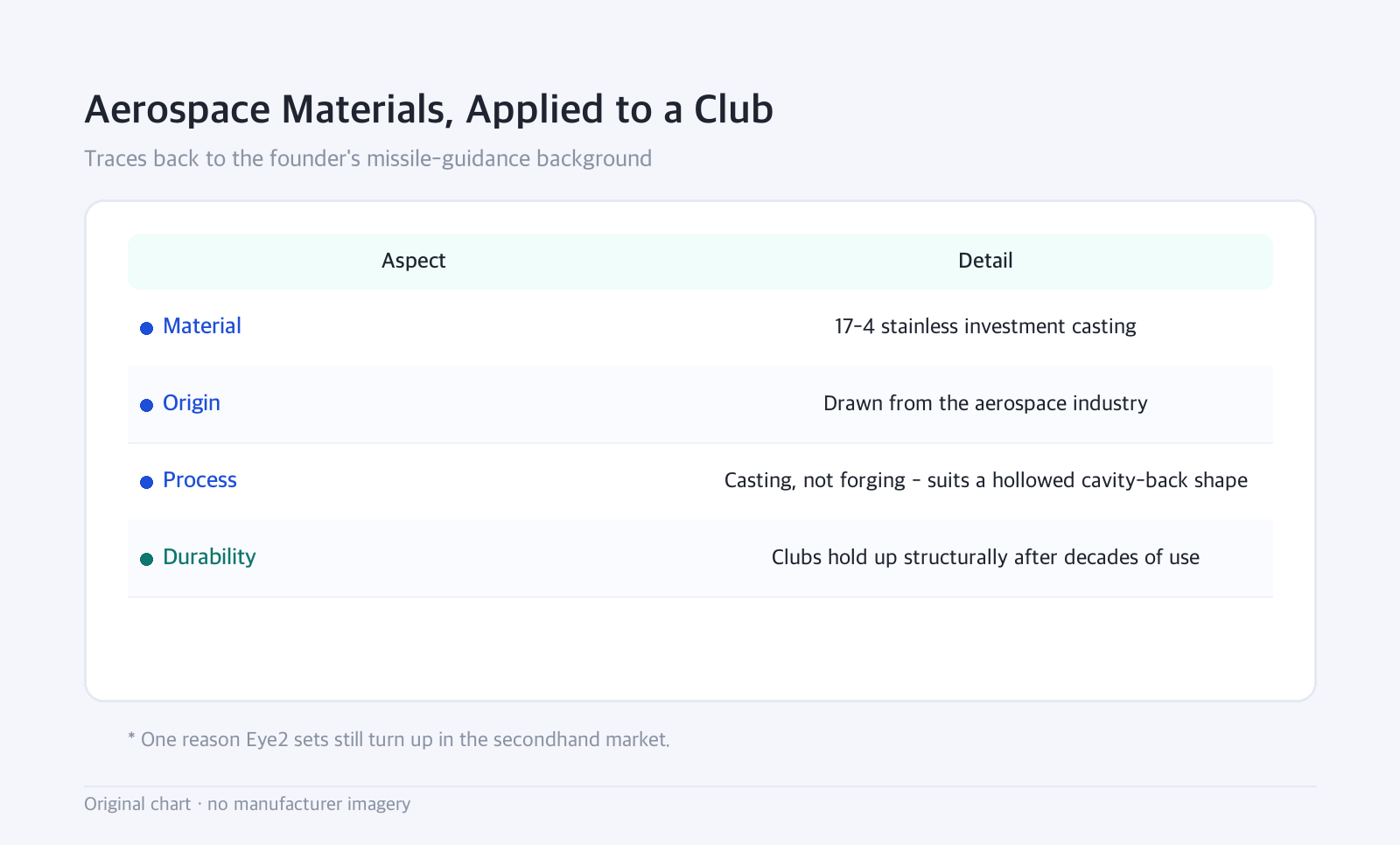
The manufacturing process is worth noting too.
The Eye2 used 17-4 stainless investment casting — a material drawn from the aerospace industry.
That traces directly back to the founder's background as an engineer who had worked on jet fighters and missile guidance systems. Materials and processes from that field were carried into golf clubs.
The effect shows up in durability. The clubs hold up structurally after decades of use — one reason the Eye2 still turns up in the secondhand market.
Casting rather than forging is also worth noting. Casting makes complex, repeatable shapes easier to produce, and mass-producing a hollowed-out cavity-back structure favors casting.
4. And square grooves
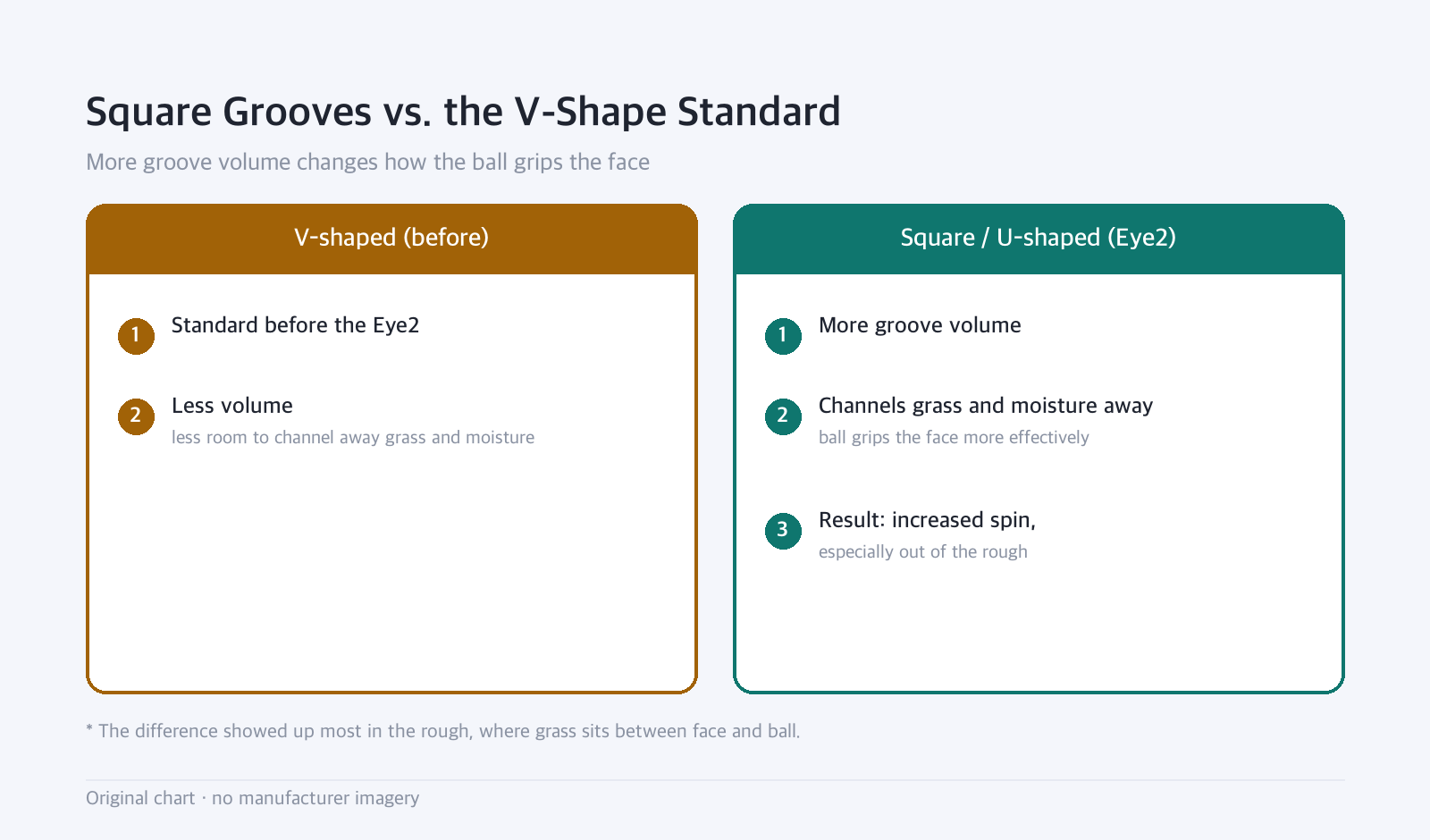
The club carried one more piece of technology: square grooves.
The cross-section of the grooves cut into the face was shaped close to square (U-shaped), where a V-shaped profile had been standard before.
Square grooves have more volume. That leaves more room to channel away grass and moisture, so the ball grips the face more effectively. The result is increased spin.
The difference showed up most in the rough. On the fairway, the face contacts the ball directly, but in the rough, grass sits between them. Larger grooves leave room to push that grass aside.
This technology triggered a dispute with the USGA in 1987. The core technology of the best-selling club in the market became a regulatory issue.
5. What sold and what caused the problem were the same thing
This is the point this piece most wants to make.
The reason the Eye2 sold well and the reason a rules body objected to it were the same technology.
- Perimeter weighting — not a problem
- Aerospace materials — not a problem
- Square grooves — a problem
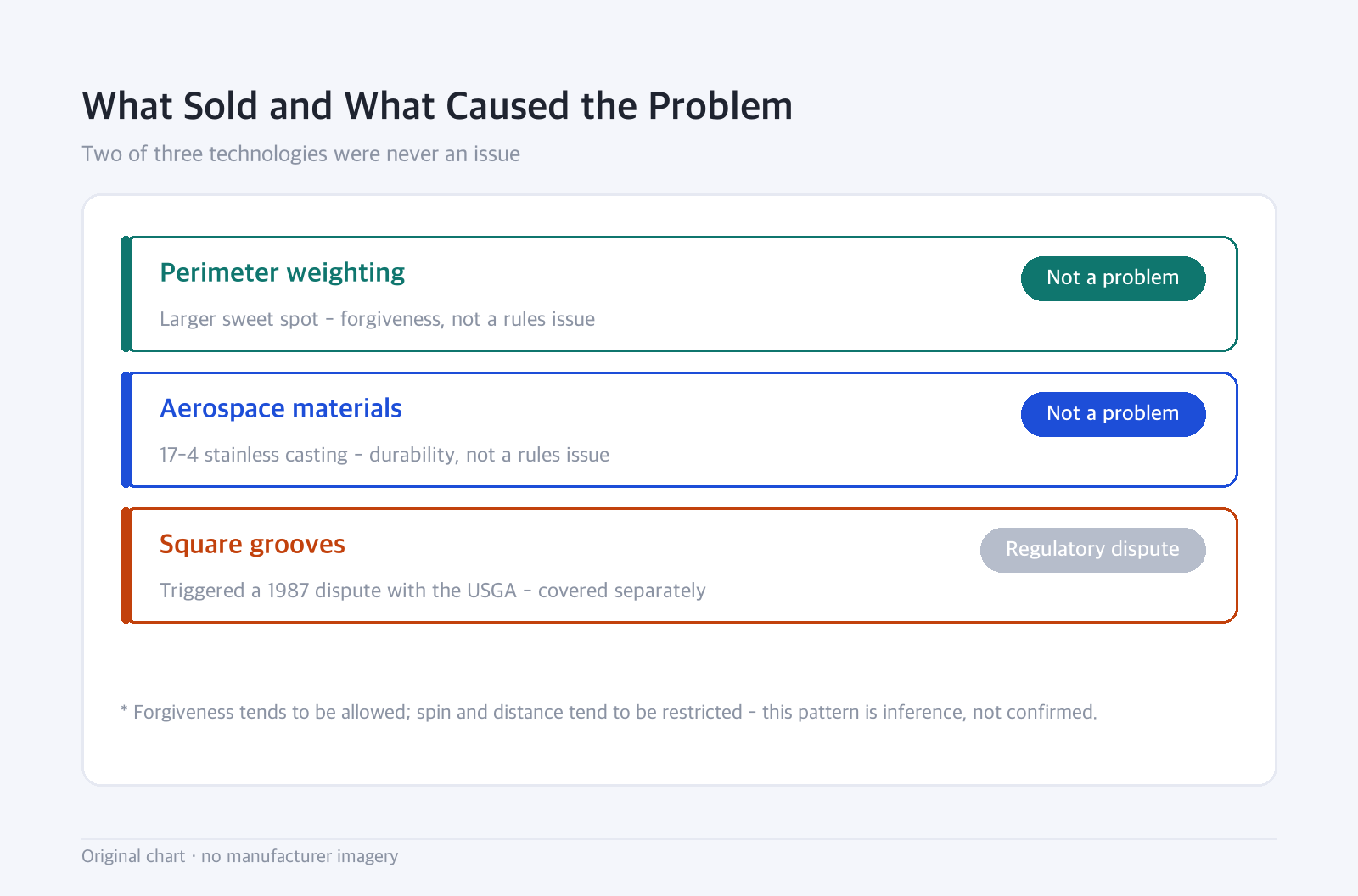
The likely reason is that the first two make a club more forgiving, while the last one changes outcomes. Regulators tend to step in at the latter kind of technology.
The 2010 groove-specification revision and the 1998 coefficient-of-restitution cap, both covered separately, follow the same pattern. Forgiveness is generally allowed; spin and distance tend to be restricted.
A plausible reason: forgiveness reduces the cost of a poor shot, while spin and distance increase the reward of a good one. The former makes golf easier without changing the structure of the game. The latter unsettles the assumptions behind course design.
This is inference, not something built on confirmed evidence.
6. Who this is useful for
Based on what could be confirmed:
- Golfers who play cavity-back irons — this is how that design took over the market.
- Golfers who look at secondhand clubs — why Eye2 sets are still around comes down to the material and process.
- Golfers interested in wedge grooves — square grooves are where that story starts.
- Golfers curious how equipment regulation is decided — forgiveness and spin get treated differently.
This is less useful for:
- Golfers currently shopping for irons — this is a 1982 product, and groove specs have since changed.
- Golfers who prefer forged irons — the Eye2 is cast.
7. What we could not confirm
- Total units sold — we could confirm the "best-selling iron" description but not a figure.
- The exact square-groove specifications — we could not confirm the cross-section shape and dimensions.
- The 1982 launch price.
- The source and methodology behind the market-share figures — we could not confirm what market the 18% and 28% figures were measured against.
- How the Eye2 differed from its predecessor.
- Whether an Eye2 would still be conforming today — we could not confirm how it was treated after the later groove-specification revision.
In one line
The PING Eye2, launched in 1982, is widely cited as the best-selling iron in history. Market share rose from 18% in 1985 to 28% in 1988.
Three technologies were involved: perimeter weighting, aerospace-grade cast stainless steel, and square grooves.
The first two were never a problem; the last one triggered a dispute with a rules body. A technology that makes a club easier to hit, and one that changes outcomes, were treated differently.
The figures and years here are drawn from confirmed sources; anything we could not confirm is marked as such.
This piece summarizes general instruction concepts and is not personalized coaching advice. Ball flight fixes depend on individual swing mechanics — a launch monitor session or certified instructor can confirm what applies to you.