Golf's rulemaking history includes a few cases where the USGA and the R&A diverged — the 1910 Schenectady putter ban and the 1920s split over steel shafts among them. Both are close to a century old now.
The most recent split isn't nearly that old. It happened in 1998.
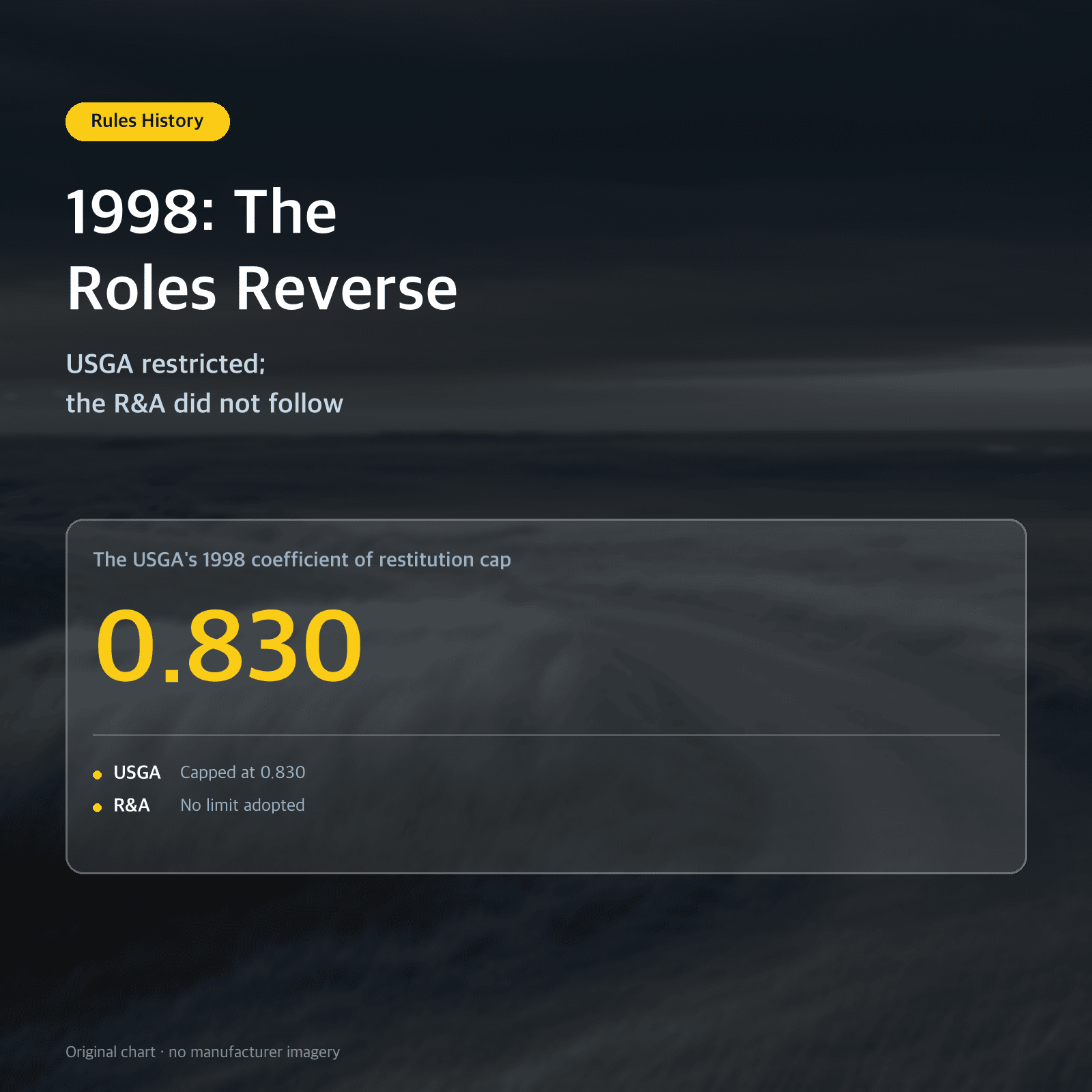
And this time, the roles were reversed. Unlike the two earlier cases, the USGA restricted and the R&A did not.
1. A driver face works like a trampoline
The issue started with something called the "spring effect."
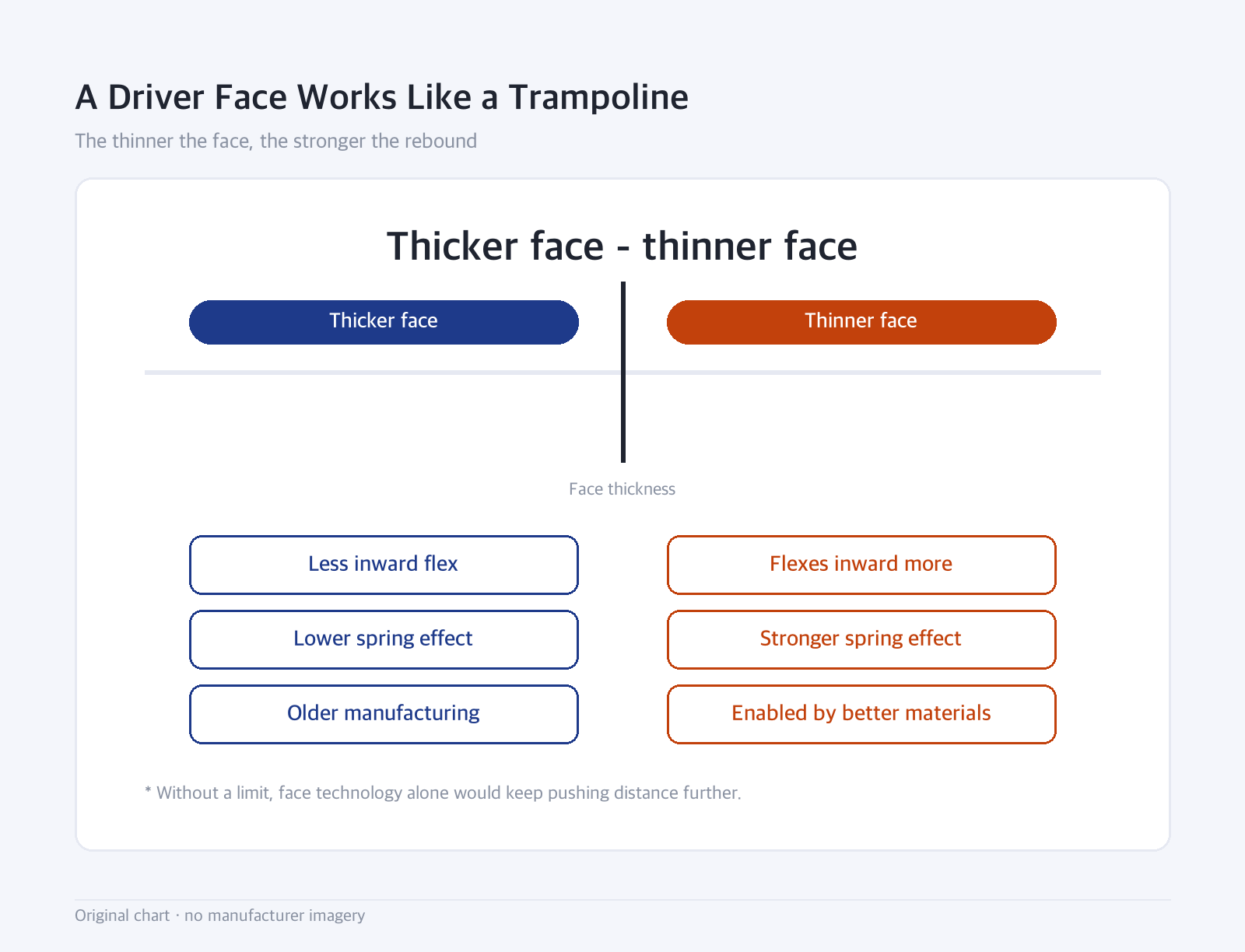
A driver face flexes inward on contact with the ball and springs back. That rebound adds energy to the ball — the same principle as a trampoline, which is why it's also called the "trampoline effect."
The thinner the face, the stronger this effect. And as materials and manufacturing improved, faces could be made progressively thinner.
That raised a question: how much spring is too much? Without a limit, face technology alone would keep pushing distance further.
2. The USGA drew a line — 0.830
In November 1998, the USGA introduced a cap on the coefficient of restitution (COR).
COR is the ratio of speed before and after impact. Closer to 1 means less energy lost in the collision.
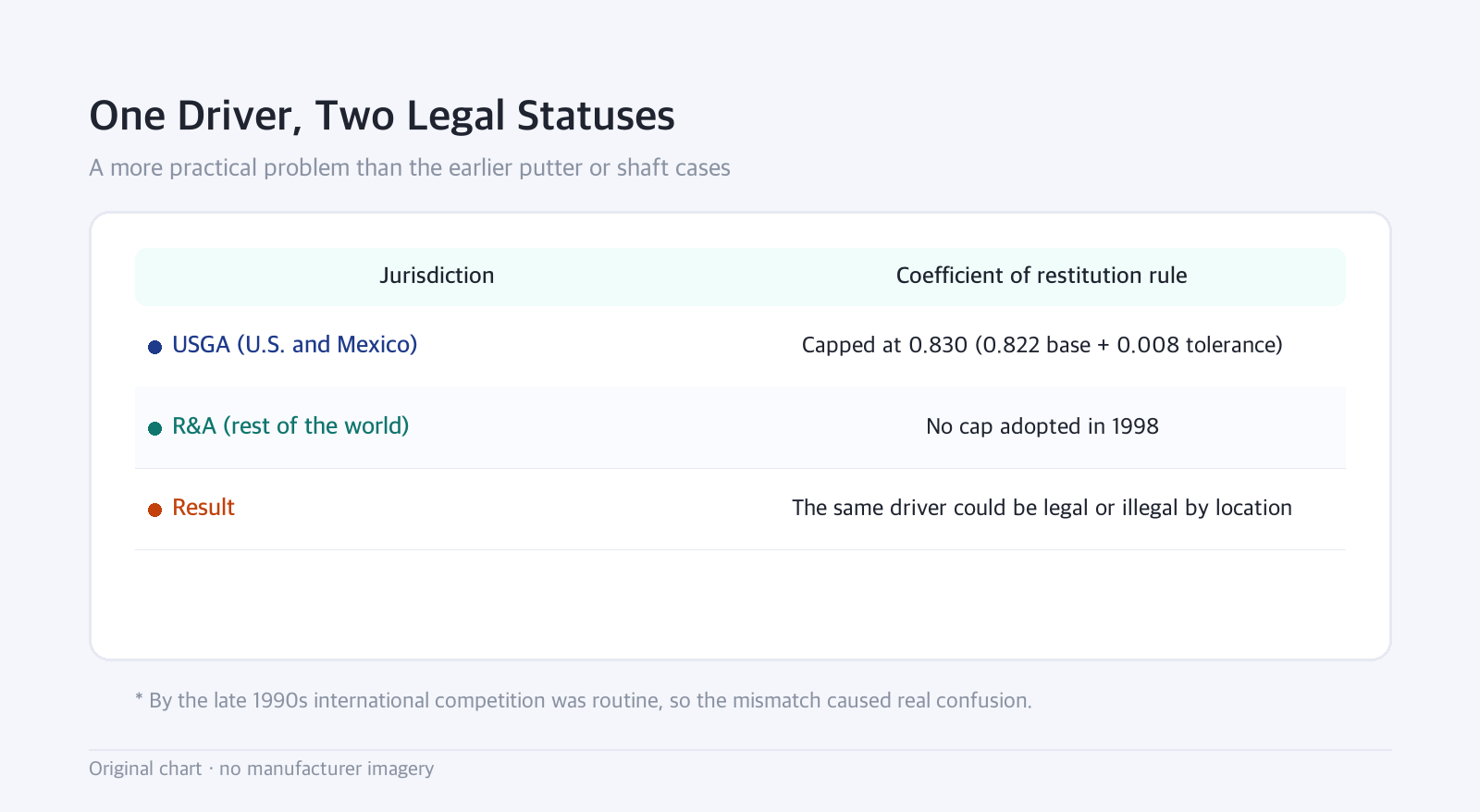
The USGA set the value at 0.830, made up of:
- a base figure of 0.822
- a testing tolerance of 0.008
- combined, an effective limit of 0.830
The tolerance exists because measurement carries error — testing the same club repeatedly produces slightly different readings, and the tolerance accounts for that spread.
This structure still holds today. The CT test introduced later also runs on a base value plus a tolerance. The numbers in golf's rules aren't single clean cutoffs — they're ranges.
3. The R&A didn't adopt it
The R&A did not adopt this cap.
The result:
- In the United States and Mexico, drivers exceeding 0.830 were illegal.
- Everywhere else in the world, there was no limit.
- The same driver could be legal or illegal depending on where it was played.
This was a more practical problem than the putter or shaft cases had been. Those were regional differences in equipment; by the late 1990s, international competition was routine. Players crossed the Atlantic to compete regularly, and a mismatch in club standards created real confusion.
Which driver could be brought to which event became an actual question.
4. Why the judgment split
This piece can't settle why the two bodies reached different conclusions. Only the outcome is confirmed.
The structure matches the earlier cases, though: a new technology appeared, and the two bodies judged its impact on the game differently.
One side judged that without a line drawn now, distance would become unmanageable. The other judged it wasn't yet at that stage. Which side was right is still hard to say — the distance debate has continued since, and in 2023 a rollback of the ball itself was announced.
One thing is clear: this wasn't a question performance data alone could settle. How much a face flexes can be measured. How much flex still counts as golf is a judgment call, not a measurement — which is why the two bodies could land on different answers.
5. What the split left behind
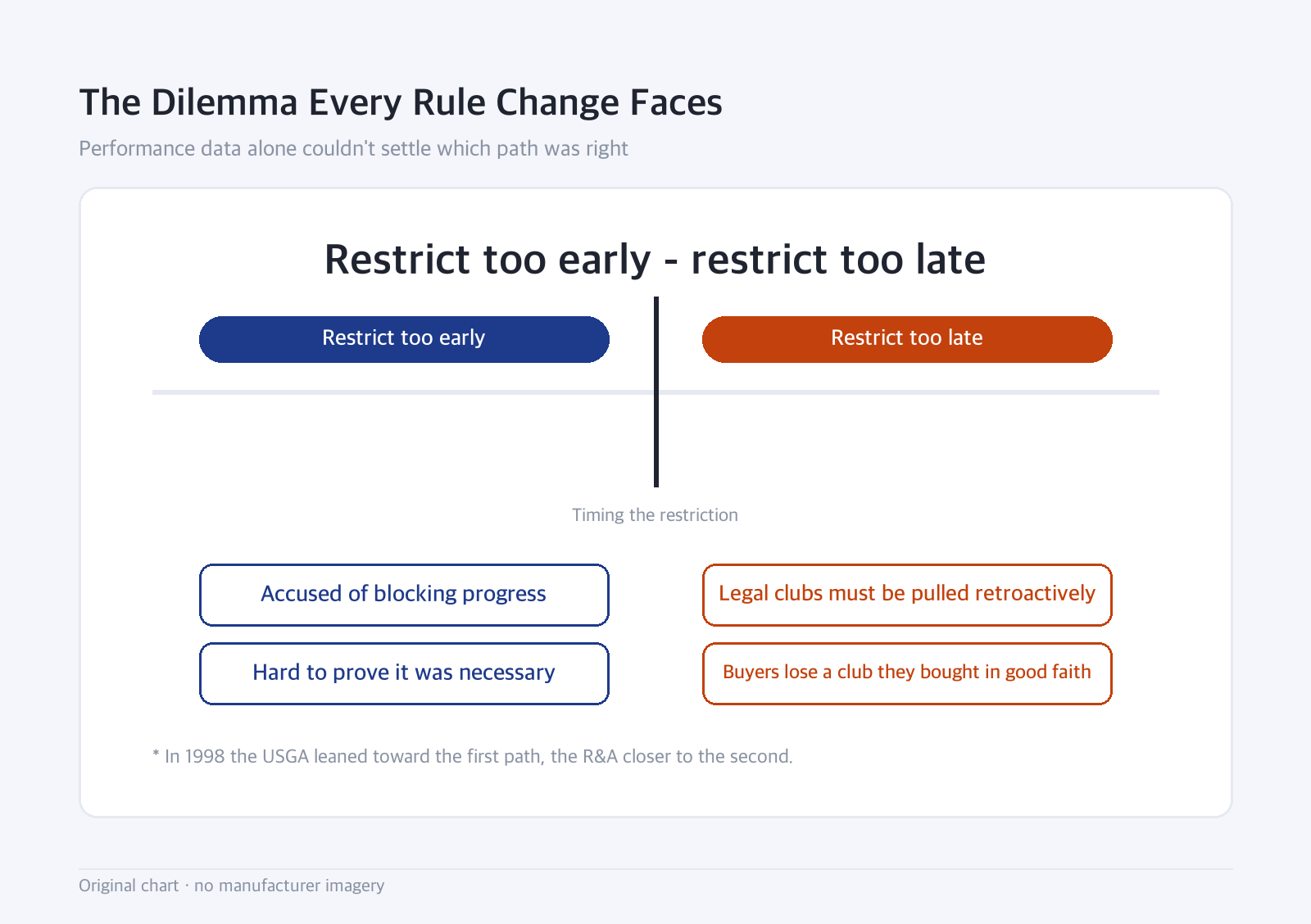
This case illustrates a dilemma rulemaking bodies face repeatedly.
Restrict too early, and you're accused of blocking technological progress — and it's hard to prove the restriction was actually necessary.
Restrict too late, and equipment already on the market has to be dealt with retroactively. Golfers who bought a club believing it legal can no longer use it.
In 1998, the USGA leaned toward the first path and the R&A closer to the second.
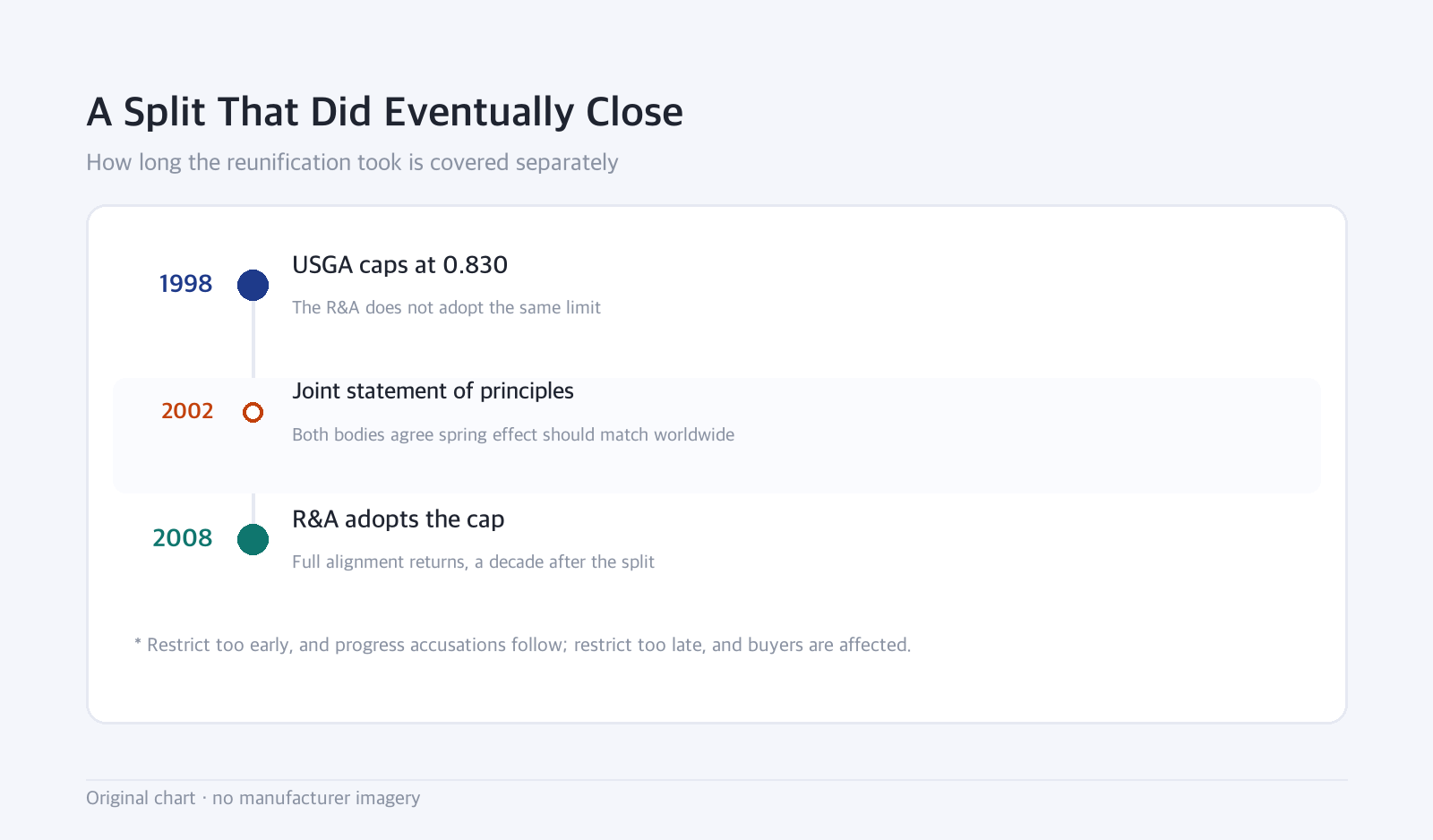
Eventually the two bodies did reach agreement — though it took time. How long is covered separately.
6. Who this is useful for
Based on what could be confirmed:
- Golfers shopping for a driver — every driver sold today is built within this cap. Face rebound is already at its ceiling.
- Golfers who've come across the term "non-conforming driver" — it usually refers to a club that exceeds this limit and can't be used in competition.
- Golfers following the distance debate — this 1998 decision is one of its starting points.
- Golfers who assume rulemaking bodies always agree — this is a case where the two reached opposite conclusions on the same issue.
This is less useful for:
- Golfers only comparing driver performance — every product on the market sits under the same cap, so this value doesn't separate them.
- Golfers who only need current rules — the two bodies' standards now match.
7. What we could not confirm
- The R&A's official reason for not adopting the cap — we found no confirmed source.
- How the 0.822 base value was arrived at — we don't know why that specific figure.
- Whether any driver sold in 1998 actually exceeded the cap.
- How international competitions handled this period — we couldn't confirm which standard applied at which events.
- The original text of the USGA's 1998 announcement.
- The course of negotiations between the two bodies.
In one line
In November 1998, the USGA set a driver coefficient of restitution cap at 0.830, and the R&A did not adopt it.
This split ran opposite to the two earlier ones, and it caused real friction because international competition was now routine.
Each time new technology appeared, the two bodies' judgments didn't line up right away — not in 1910, not in the 1920s, and not in 1998.
The figures and dates here come only from confirmed sources, and anything unconfirmed is marked as such.
This piece summarizes general instruction concepts and is not personalized coaching advice. Ball flight fixes depend on individual swing mechanics — a launch monitor session or certified instructor can confirm what applies to you.