
The physics of the miss ran to thirty pieces. This closes it out.
It started from one fact: the ball-flight law taught for decades was wrong.
From there it moved through slices, hooks, shanks, and misses by club. But across thirty pieces, the same structure kept coming back. This piece pulls that together.
1. What the five groups covered
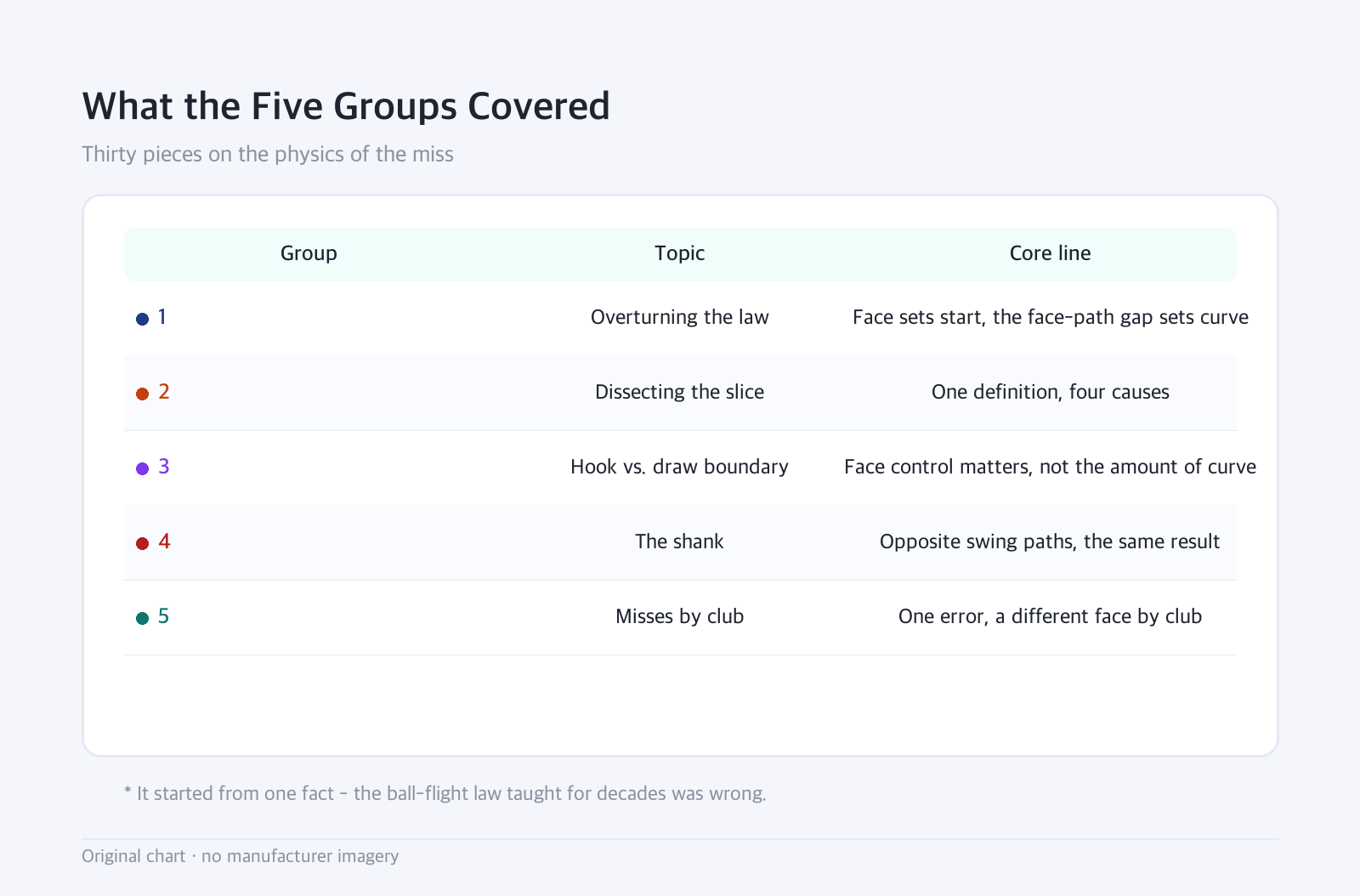
Group one — overturning the law. Starting direction is set by the face; curve is set by the gap between face and path. The model arrived in 1994, and radar measurement confirmed it in 2006.
Group two — dissecting the slice. One definition, four causes: grip, face, path, body.
Group three — the boundary between a hook and a draw. Not the amount of curve but whether the face is under control, confirmed through starting direction.
Group four — the shank. Two opposite swing paths produce the same result — the most extreme case in this material.
Group five — misses by club. The swing error is one thing, but the club turns it into a different face each time.
2. What repeated, one — diagnosis has to branch before a fix can
This ran through all thirty pieces.
A slice split into four branches, a hook into three cells, a shank into five causes. The same result called for different fixes depending on the branch.
And every time a branch was mismatched, the same thing followed: prescribe a grip fix for a path problem and it slides toward a hook. With a shank, it's worse — guess wrong and it gets worse.
The prescription wasn't wrong; the branch was mismatched. That distinction was the backbone of this material.
3. What repeated, two — covering a symptom lets the cause grow
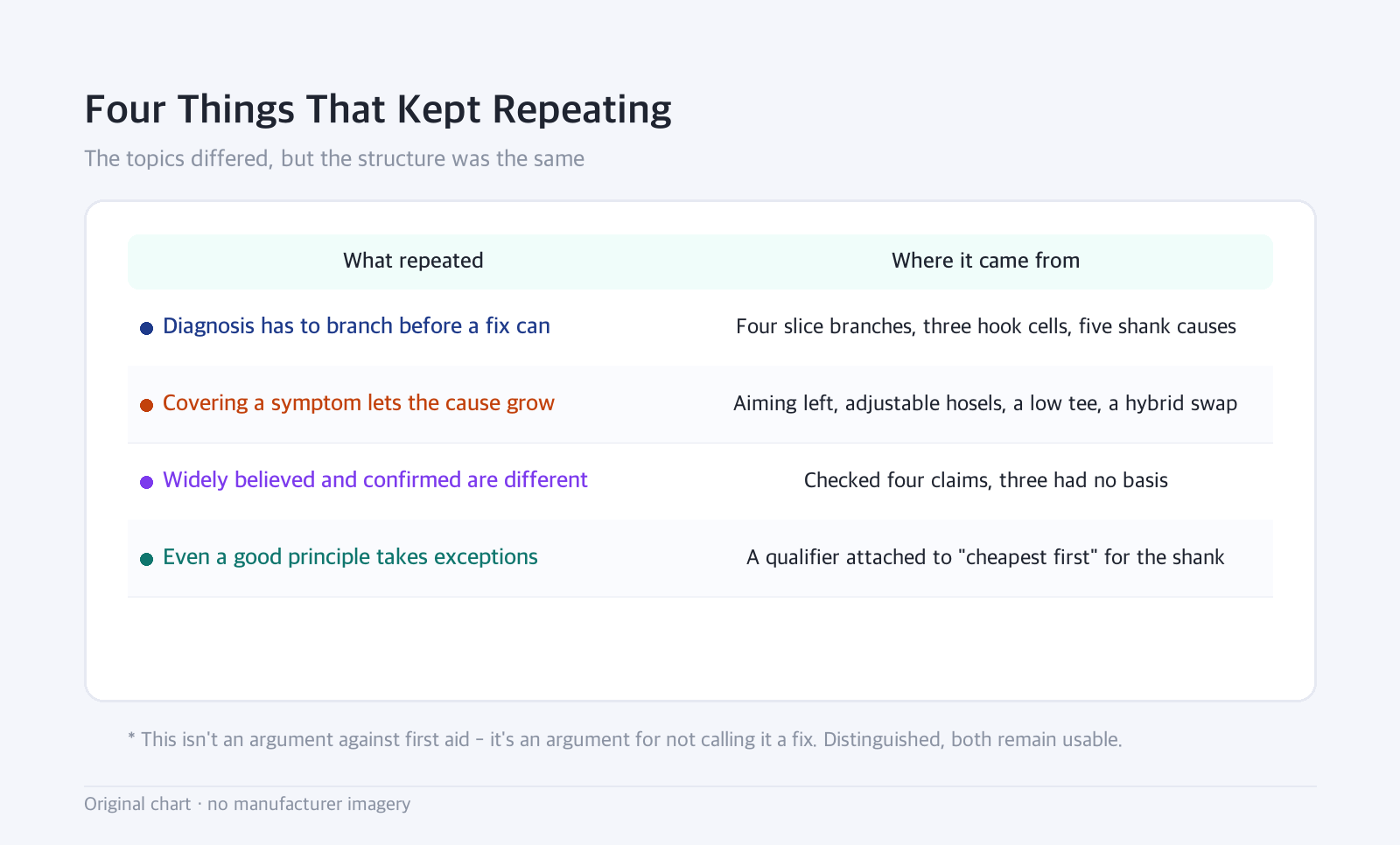
This kept coming back too.
Aiming left did it. A slice led to standing left, which pushed the path further left, which grew the slice.
Adjustable hosels did it. Adjusting loft moves the face with it, but it doesn't remove the cause.
A low tee did it. Contact improves, the slice stays, and a steep swing gets reinforced.
A hybrid swap followed the same structure. The miss doesn't disappear — it moves from distance to direction.
That's not an argument against using any of these. It's an argument for distinguishing first aid from a fix. Once distinguished, both are usable.
4. What repeated, three — what's widely believed and what checks out are different
Four well-known claims got checked across this material.
- "90 percent of golfers slice" — we could not find a rigorous survey behind it
- "a shank is contagious" — the belief exists; contagion itself wasn't confirmed
- Ben Hogan's rattlesnake line — confirmed, from a 1955 Sports Illustrated interview
- Two more claims from an earlier golf-history piece also turned out to lack a basis
One out of four held up.
The ratio isn't the point here. The point is that there was no way to know in advance. All four sounded equally plausible going in.
The goal isn't to debunk — it's to draw the line between what's confirmed and what isn't.
5. What repeated, four — even a good principle takes exceptions
The diagnostic principle running through this material was "cheapest first" — clear the low-cost checks before the expensive ones.
Counting knuckles took a minute; ten starting directions was enough to split a branch.
But the shank added a qualifier: "the higher the cost of a wrong guess, the more it's worth spending to check it."
Two opposite branches exist, and a wrong guess makes things worse, so swing path came last — only set once at least two pieces of evidence agreed.
A good principle doesn't apply unchanged everywhere. That's one more thing this material leaves behind.
6. So what should you do with this
Thirty pieces, compressed into three lines:
First, separate starting direction from curve. Half of it can be read without a launch monitor. That habit alone changes a lot.
Second, find your branch before picking a fix. Reverse the order and it takes longer, or gets worse.
Third, use first aid, but don't call it a fix. Distinguish the two and both remain usable.
One more thing. Stop at the point where the issue becomes physical. Early extension, a stalled turn, weight shift — this material said so three times. These can't be sorted by reading, and pushing further risks injury.
7. Who this is useful for
- Readers who've gone through all thirty pieces — this one stands in for a table of contents
- Readers deciding where to start — find your miss among the five groups in section 2
- Golfers setting a practice direction — the three lines in section 6 are it
- Readers curious how the claims in this material were checked — section 4 shows the approach
Less useful for:
- Readers looking for a specific prescription — this piece is a summary; the substance is in the other twenty-nine
8. What this material could not confirm
Collected from the larger items noted along the way:
- The actual distribution across the four slice branches and five shank causes — we could not find statistics on which is most common
- The accuracy of the self-diagnosis sequence — no validating data exists; use it as a branching framework, not a verified test
- The original source of the various rules of thumb — 85 percent, 12 yards per degree, three knuckles, and similar figures are common conventions
- How well any of this generalizes across different amateur populations — most of the underlying research came from a small number of golf markets
Summary
A miss is an outcome, and the same outcome can have several causes.
Which is why, across thirty pieces, diagnosis came before prescription. Sort the branch, and the fix follows.
And what couldn't be confirmed was marked as such. Three of four widely repeated claims had no basis; one did. There was no way to know which, until we looked.
Thanks for reading.
This piece summarizes general instruction concepts and is not personalized coaching advice. Ball flight fixes depend on individual swing mechanics — a launch monitor session or certified instructor can confirm what applies to you.