
Look down at a driver from above. The face is not flat — it bulges slightly outward at the center.
Viewed from the side, it curves top to bottom too.
The front-to-back curve is called bulge, the top-to-bottom curve roll. Iron faces, by contrast, are flat. Why does only the driver curve?
This piece closes out the series.
1. A design built to answer the previous piece's problem
A separate piece covers gear effect: off-center contact rotates the head, and the ball picks up spin in the opposite direction. Toe strikes add hook spin, heel strikes add slice spin.
Because a driver's center of gravity sits far from the face, this effect is large. Every mishit throws direction off by a wide margin.
Bulge is a design meant to offset exactly that.
Consider what a convex face does. The toe side of the face angles outward. So a ball struck toward the toe starts to the right. Then gear effect adds hook spin, curving it back left.
It starts right and comes back left. The heel side works in reverse.
The mishit partially cancels itself out.
2. So how much curvature is correct
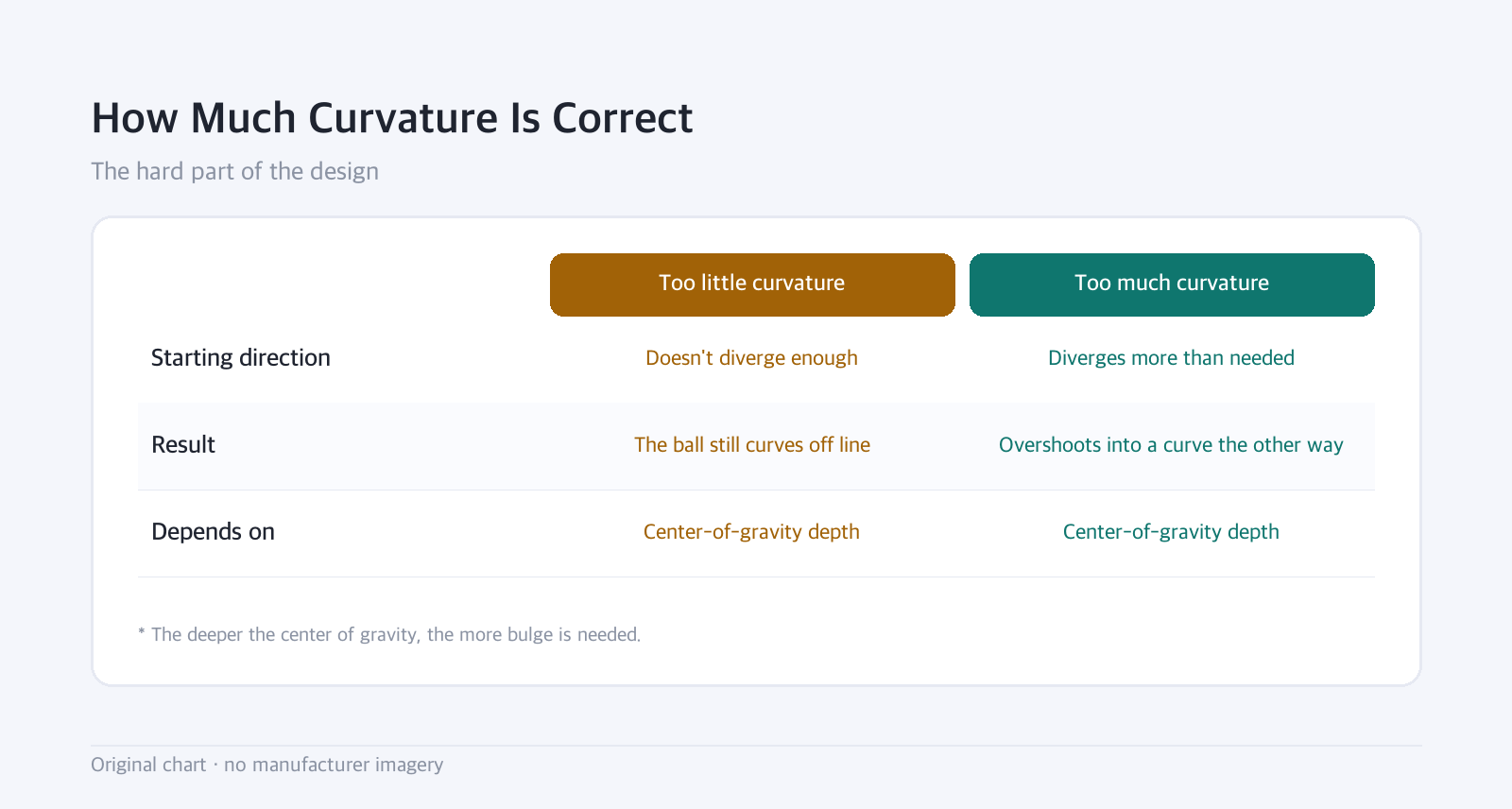
This is the hard part of the design.
Too little curvature and the starting direction doesn't diverge enough to offset gear effect. The ball still curves.
Too much curvature and the starting direction diverges more than needed to compensate, overshooting into a curve the other way.
So what does the correct answer depend on?
The size of gear effect. And as covered separately, that size is set by how far the center of gravity sits from the face.
The deeper the center of gravity, the more bulge is needed. This correlation was worked out experimentally, and the record survives.
3. 1941, two men at Spalding

In 1941, John W. Baymiller and Robert W. Vose of A.G. Spalding & Bros. filed a patent on clubhead design. US Patent 2,395,837, filed 14 May 1941 and granted 5 March 1946.
The goal was reducing the directional error produced by heel and toe strikes.
What they found through testing is the correlation above: the correct amount of bulge depends on how far back the center of gravity sits inside the head.
Worth noting: bulge on clubs itself predates this patent by a wide margin. It was in use back in the wooden-head era.
What Baymiller and Vose did was less an invention than an evidentiary foundation — attaching testing and a correlation to something already done by feel.
This mirrors the structure of an earlier piece in this series: the physicist behind the corrected ball-flight model didn't create a new phenomenon either — he explained something already happening.
4. Why irons don't have it
Back to the opening question.
An iron's center of gravity sits close to the face. So gear effect stays small even on a mishit.
Nothing large to offset means no offsetting device is needed. That's why iron faces stay flat.
Iron mishits show up elsewhere instead — as distance loss, not direction loss, exactly as covered in the previous piece.
5. What this series has established

Pulling the pieces in this series together:
First, the old ball-flight model was wrong. Starting direction is set by face angle, not path; curve is set by the gap between face and path.
Second, a correct explanation doesn't become common knowledge without a way to confirm it. Twelve years separated a 1994-era model from a 2006 launch monitor.
Third, diagnosis splits on three questions: where it started, which way it curved, by how much.
Fourth, all of this carries a condition: it describes center contact.
Fifth, equipment design already accounts for this physics. A curved face and a center of gravity pushed back sit on the same calculation.
Understand the laws and mishits become legible. Understand mishits and equipment shapes become legible too.
6. Who this is useful for
- Golfers shopping for a driver — center-of-gravity depth and face curvature are designed as a matched pair.
- Golfers curious why some mishits stray less off-line — this is half of what "forgiveness" means.
- Golfers whose driver and iron misses differ — the face shape itself is different.
- Golfers reading equipment coverage — bulge and roll are design specs, not marketing terms.
This is less useful for:
- Golfers looking to modify a face themselves — curvature is bound to head design and isn't adjusted independently.
- Golfers wanting to fix a slice right now — diagnosis and fixes by branch are covered separately.
7. What we could not confirm
- When bulge was first applied — we could only confirm that it dates back to the wooden-head era.
- The standard bulge radius on current drivers — it varies by manufacturer and published figures are limited.
- How much roll actually offsets vertical mishits — we could not confirm numbers for this effect.
- How widely the industry adopted the correlation from Patent 2,395,837 — we could not confirm.
In one line
The driver face is curved to partially undo mishits.
A toe strike is sent right, and gear effect curls it back left. Two errors designed to cancel each other.
And how much bulge is correct — depending on center-of-gravity depth — was worked out experimentally by two people in 1941.
Golf equipment has never beaten the physics. It has been built to use it instead.
This piece summarizes general instruction concepts and is not personalized coaching advice. Ball flight fixes depend on individual swing mechanics — a launch monitor session or certified instructor can confirm what applies to you.