Separate pieces have traced this thread across 260 years: in 1764 St Andrews reshaped its course because the ball was going too far, in 1898 the rubber-core ball reached 250 yards with no restriction, and in 1998 and 2010 lines were drawn on clubs.
In 2023, it was finally the ball's turn.
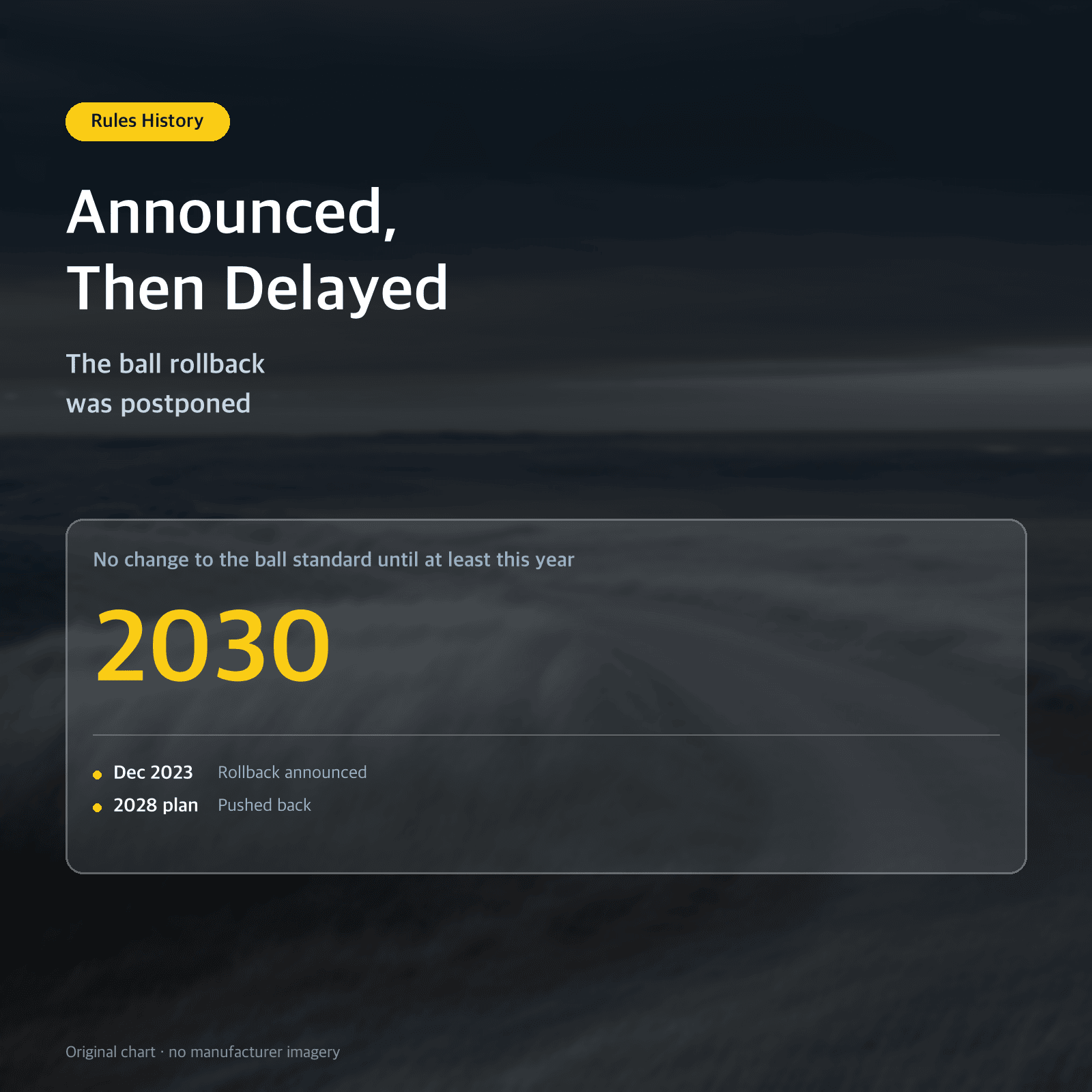
But this story isn't finished. The announcement came — and then implementation was pushed back.
1. December 2023, the announcement
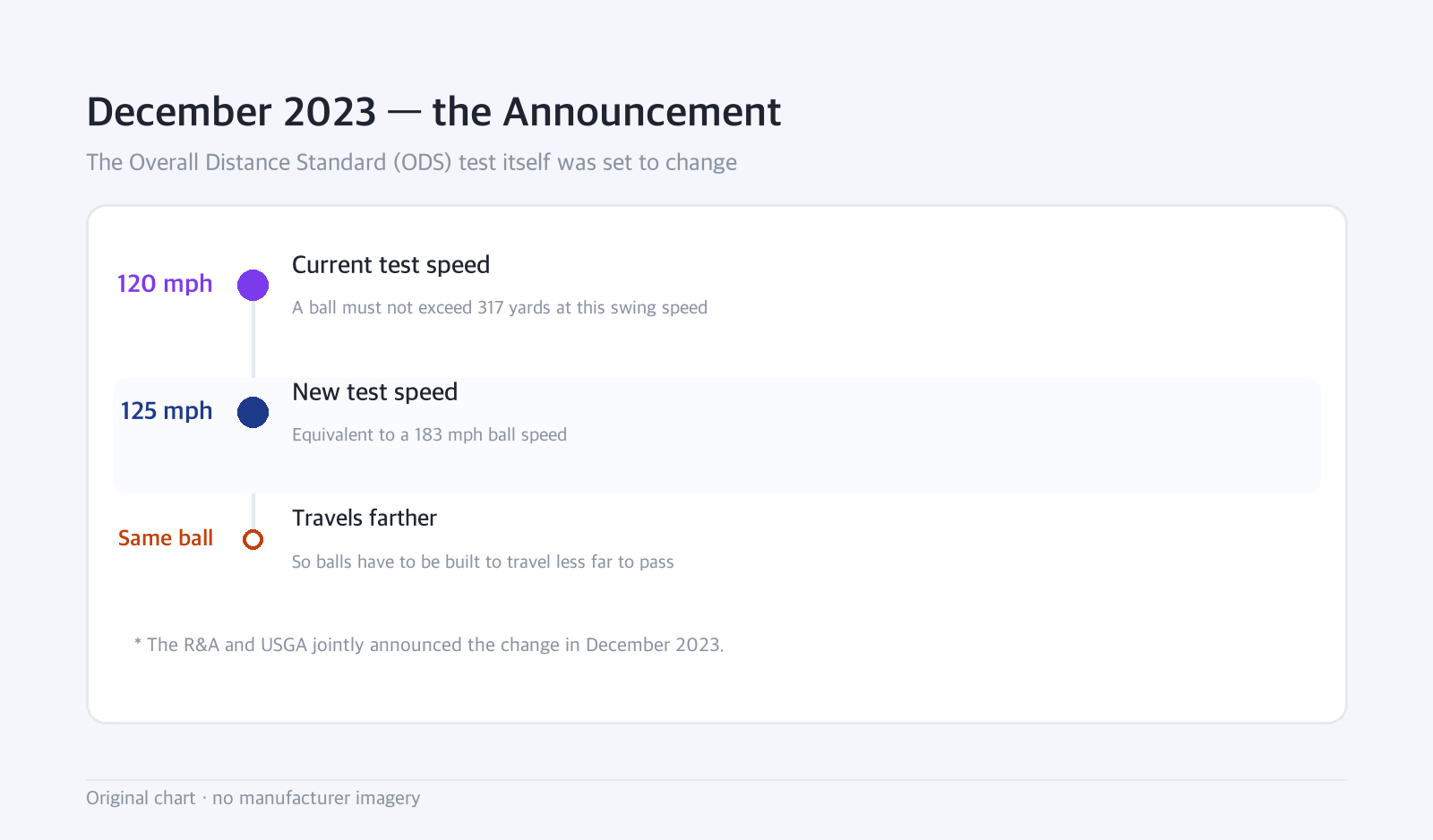
In December 2023, the R&A and USGA announced they would change the distance standard for golf balls.
What changes is the testing procedure called ODS (Overall Distance Standard).
The current standard is:
- A ball must not exceed 317 yards when struck at a 120 mph swing speed.
The new standard raises the test conditions:
- Testing at a 125 mph swing speed (equivalent to a 183 mph ball speed).
The same ball, tested under faster conditions, travels farther. So to pass the new standard, balls have to be built to travel less far.
2. How much less
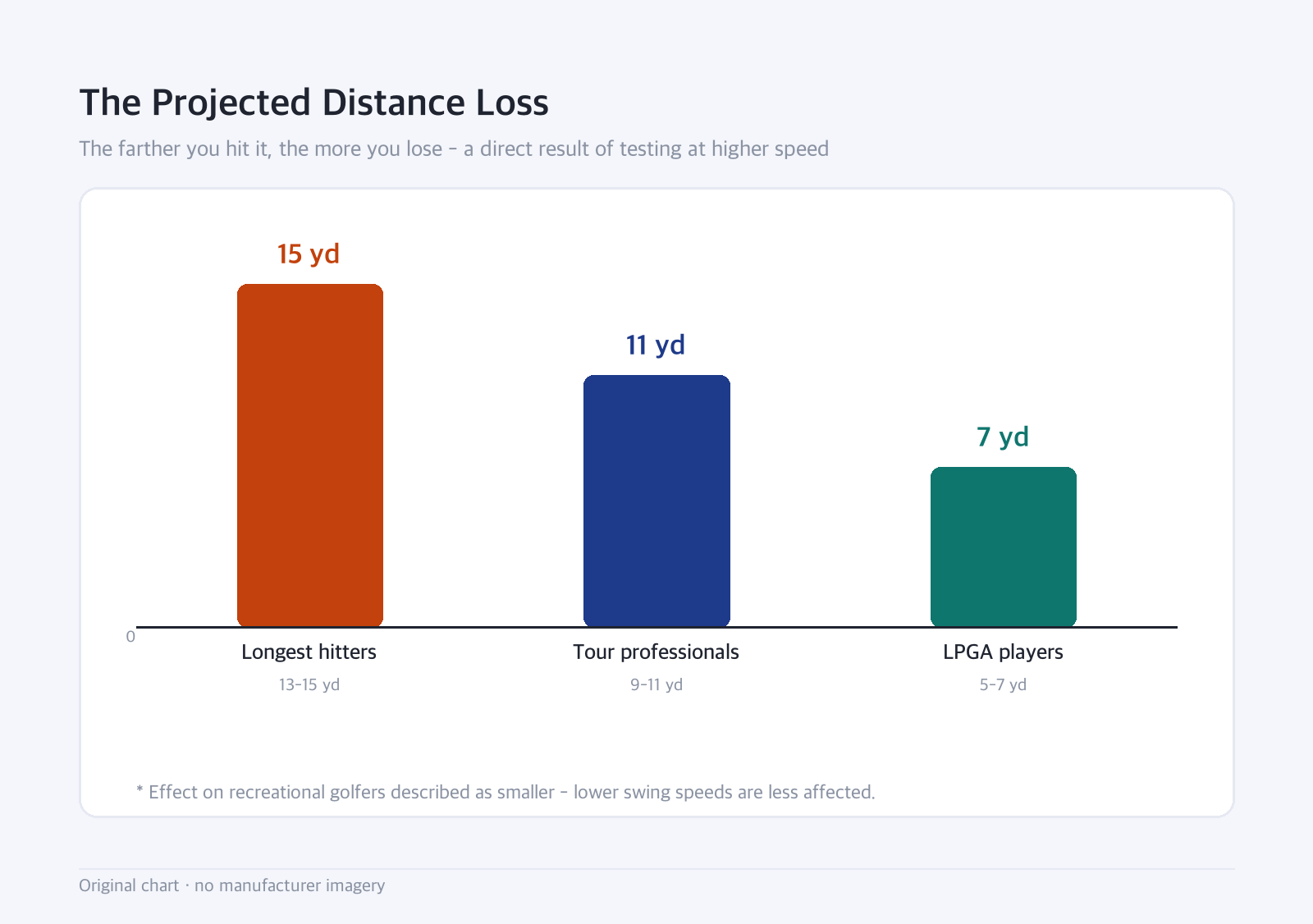
The projected figures announced were:
- The longest hitters — a 13–15 yard reduction.
- Average tour professionals — a 9–11 yard reduction.
- LPGA players — a 5–7 yard reduction.
The farther you hit it, the more you lose — a direct result of testing at higher speed. The effect on recreational golfers was described as smaller, since lower swing speeds are less affected by the new standard.
3. The original timeline, and the one that replaced it
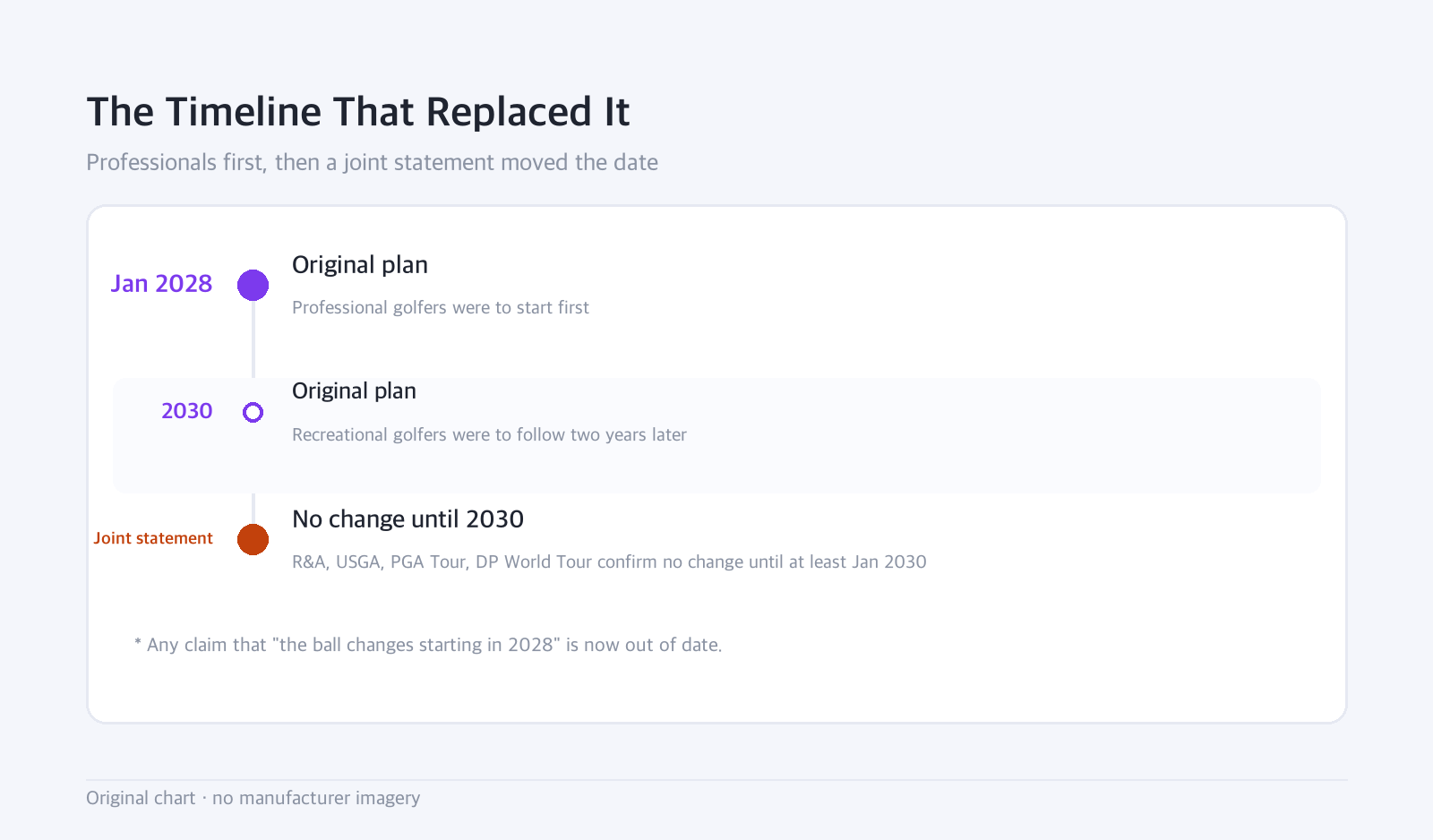
The originally announced timeline was:
- Professional golfers — from January 2028.
- Recreational golfers — from 2030.
Professionals first, with the wider rollout two years later.
Then the timeline changed.
The R&A, USGA, PGA Tour, and DP World Tour issued a joint statement confirming that there would be no change to ball testing standards until at least January 2030.
In effect, the professional implementation date moved from 2028.
Any current claim that "the ball changes starting in 2028" is out of date. As of this writing, the confirmed position is the joint statement above.
4. An admission that it "probably won't be enough"
One remark stands out in this story.
The head of the USGA acknowledged that the rollback would "probably not be enough."
That's a rule-maker naming the limits of its own measure. The reasoning isn't hard to guess: distance isn't determined by the ball alone. Clubs, shafts, player size and training, and course conditions all play a part.
Rolling back one variable — the ball — doesn't solve the distance question on its own, and the people making the rule seem to know it.
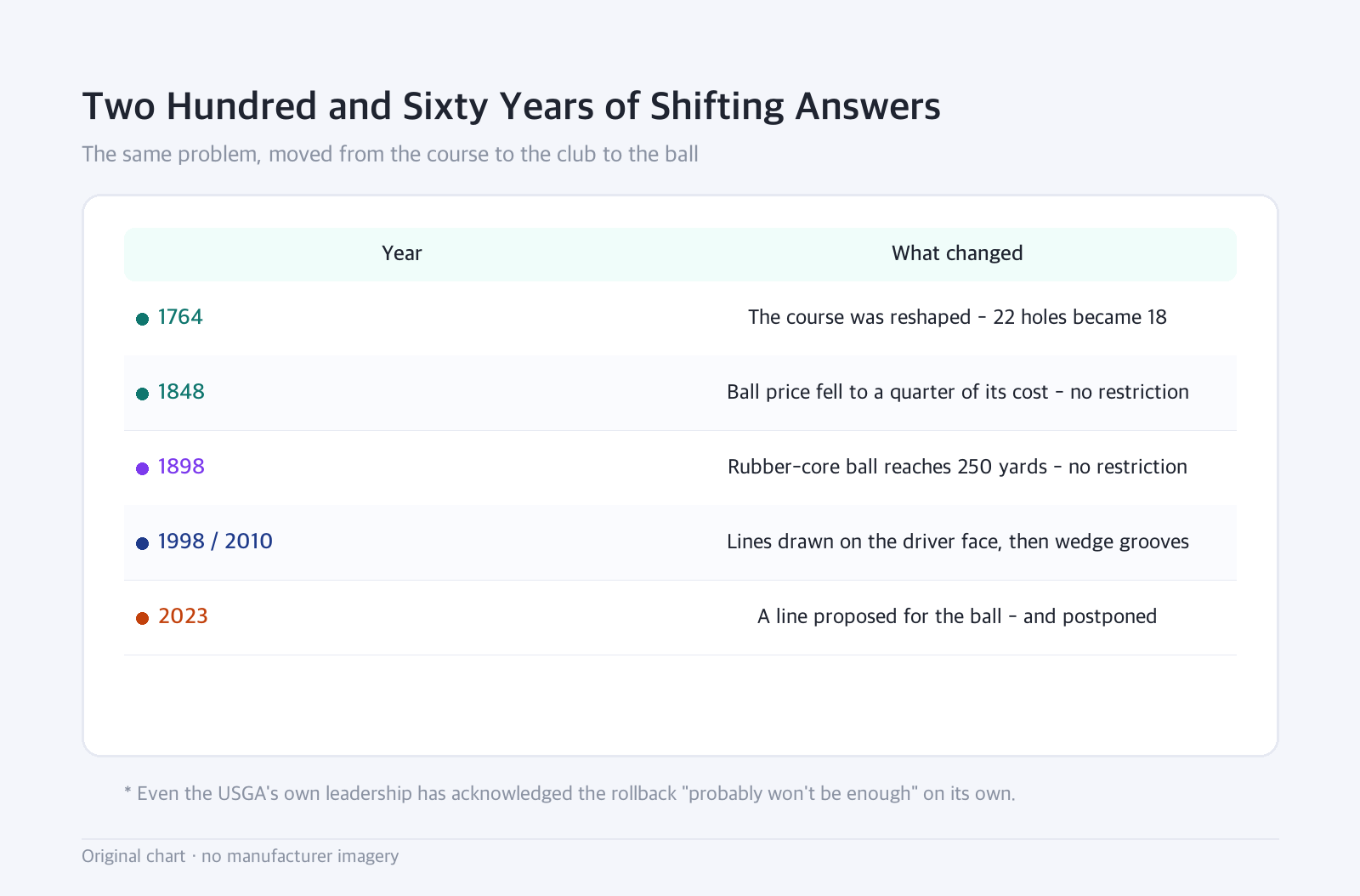
5. Two hundred and sixty years of shifting answers
Following this thread from the start:
- 1764 — the course was reshaped: 22 holes became 18.
- 1848 — the price of a ball fell to a quarter of its former cost, and golf became widely accessible. No restriction.
- 1898 — 250 yards. No restriction.
- 1998 — a line drawn on the driver face.
- 2010 — a line drawn on wedge grooves.
- 2023 — a line proposed for the ball — and postponed.
The answer to the same underlying problem has moved from the course, to the club, to the ball. And each time, it hasn't come easily.
The most recent attempt is also taking the longest — echoing the ten years it took to unify the two governing bodies' COR limits. The cost of change has grown along with the stakes.
In 1764, a single club could simply combine holes on its own course. Today, manufacturers, tours, and golfers worldwide are all affected. The same kind of decision now carries far more weight.
6. Who this is useful for
Based on what could be confirmed:
- Golfers buying balls right now — nothing changes in the near term. The confirmed position is no change to the standard until at least January 2030.
- Golfers who heard "the ball changes in 2028" — that timeline has been pushed back.
- Golfers following the distance debate — even the rule-makers say this measure may not be enough on its own.
- Golfers curious how fast rule changes move — the gap between announcement and implementation can be long, and the timeline itself can shift within that gap.
This is less useful for:
- Recreational golfers generally — the projected reduction is larger at higher swing speeds; the effect on most golfers is expected to be small.
- Anyone choosing a ball right now — current-standard balls remain the right choice for now.
7. What we could not confirm
- The new implementation date — we could confirm "no change until at least January 2030" but not what comes after.
- The specific reasoning behind the postponement — we did not review the full text of the joint statement.
- The basis for the projected distance reductions — what conditions were simulated, we could not confirm.
- Manufacturer responses — whether preparation is already underway, we could not confirm.
- The implementation timeline for recreational golfers.
- Additional discussion of driver regulation — reportedly under discussion, but nothing confirmed.
In one line
In December 2023, an announcement was made to change the ball distance standard, raising the test swing speed from 120 mph to 125 mph so that balls would have to be built to travel less far.
But implementation was postponed. The standard remains unchanged until at least January 2030 — so any claim that it starts in 2028 is out of date.
For 260 years, the answer to "the ball goes too far" has kept shifting — from the course to the club, from the club to the ball — and this latest answer has yet to take effect.
The figures and timeline here come from confirmed sources; anything we could not confirm is marked as such.
This piece summarizes general instruction concepts and is not personalized coaching advice. Ball flight fixes depend on individual swing mechanics — a launch monitor session or certified instructor can confirm what applies to you.