
A companion piece, covered separately, described how PING started in a garage, and how the company name came from the sound of a putter at impact.
This one is about the product that made the company: the Anser.
Two stories attach to this putter — where it was sketched, and who named it.
1. January 1966, a record album sleeve
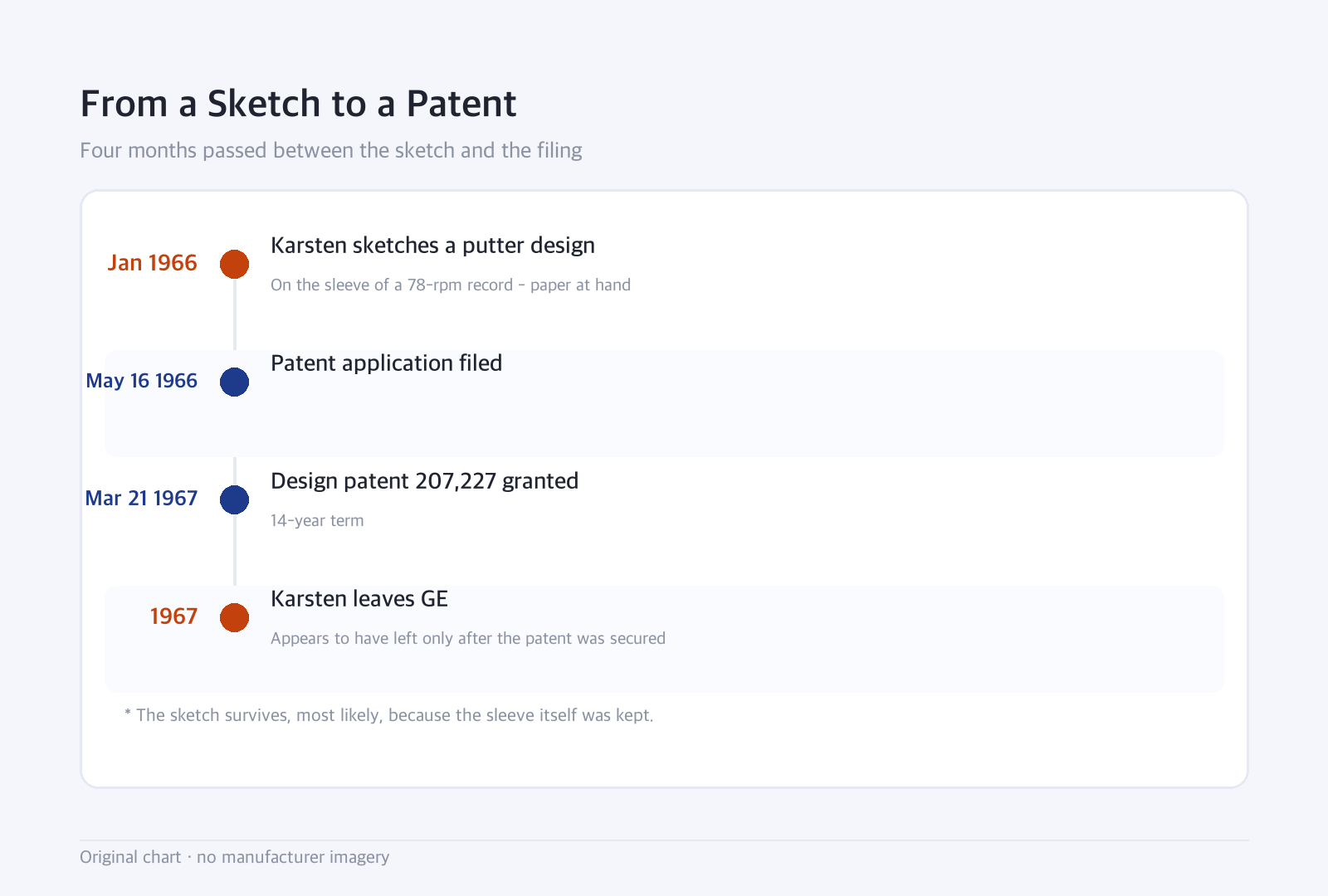
In January 1966, Karsten Solheim sketched a putter design.
He drew it on the sleeve of a 78-rpm record. He needed paper, and that was apparently what was at hand.
That sketch became the basis of a shape that has carried through to today.
The anecdote likely survives because the sleeve itself was kept. A hurried drawing that turned into a design, and that design into a company, would be hard to throw away.
2. What it changed — offset and cavity-back
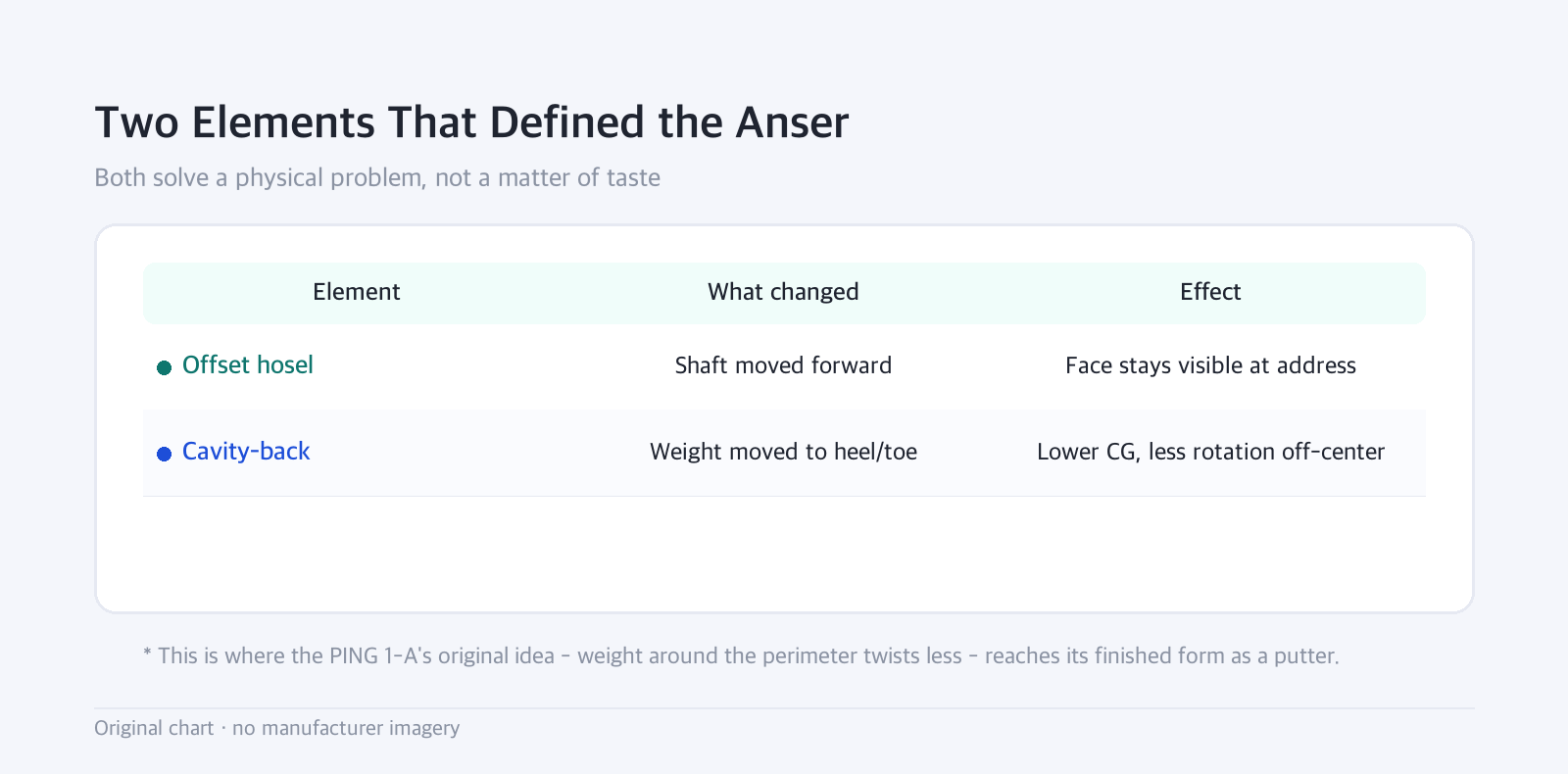
The Anser's design comes down to two elements.
Offset hosel
The shaft attachment point was moved forward, setting the face back. At address, this means the shaft and hands no longer block the golfer's view of the face.
That was the point for Solheim: aiming while looking straight at the face.
Cavity-back
The back of the head was hollowed out, and that weight moved to the heel and toe. Two results followed:
- A lower center of gravity
- Less head rotation on an off-center hit
This is where the idea behind the PING 1-A, covered separately, reaches its finished form: "put weight around the perimeter, and the head twists less even off-center," now shaped into a putter.
3. His wife shortened the name
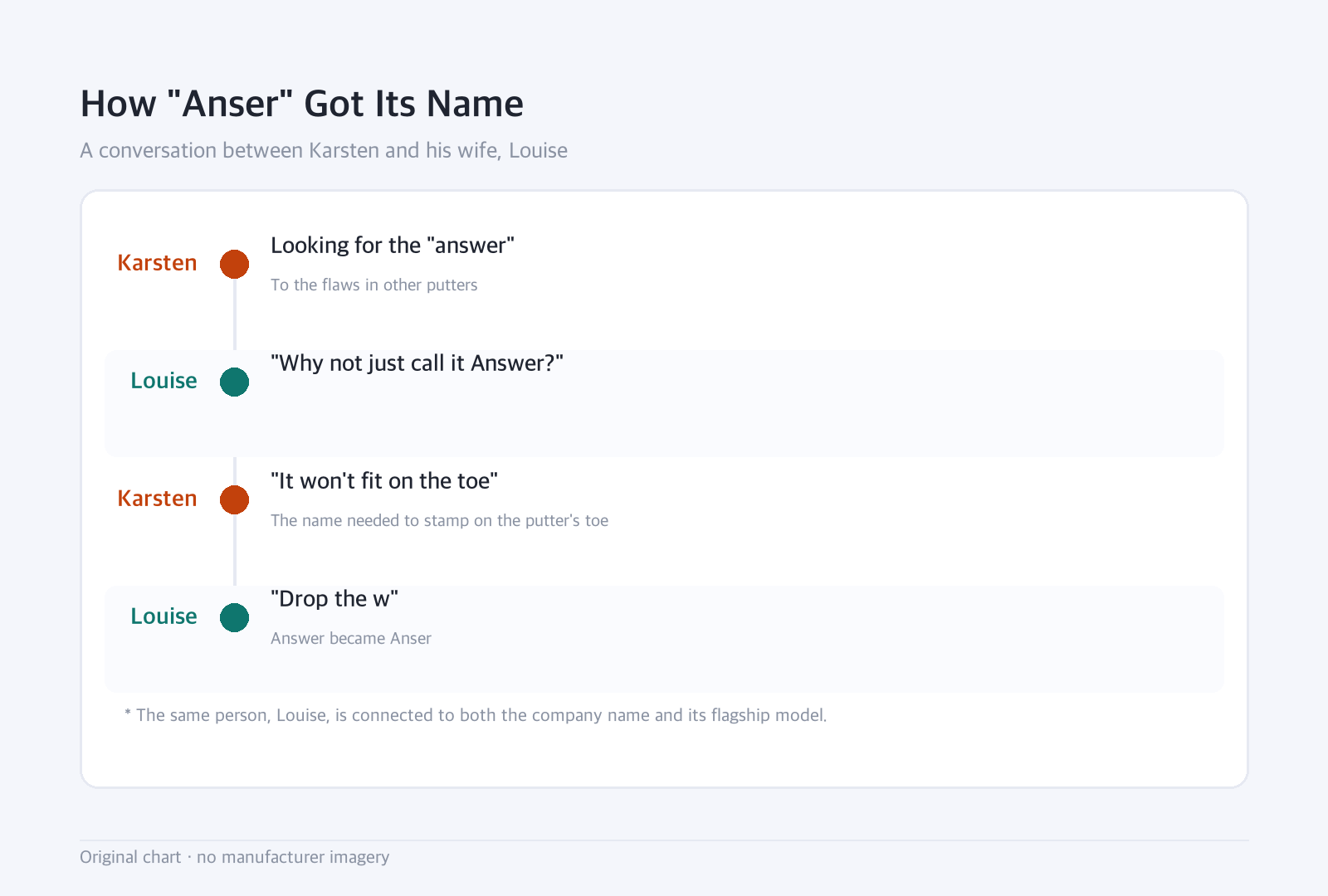
There is an anecdote attached to the name as well.
Karsten told his wife, Louise, that he was looking for the answer to the flaws in other putters.
Louise suggested: "Why not just call it Answer?"
Karsten replied: "It won't fit on the toe." The putter head needed the name stamped on the toe, and the word was too long.
Louise said: "Drop the w."
That became Anser.
The companion piece, covered separately, noted that the origin of the company name PING is also preserved through Louise's own account. The same person is connected to both the company name and its flagship model.
4. It was patented
Once the design was finalized, a patent was filed.
- Filed May 16, 1966
- Design patent 207,227 granted March 21, 1967
- 14-year term
The sketch was in January, the filing in May — four months.
And in 1967, the year the patent was granted, Karsten left GE. Eight years of splitting time between the day job and the garage ended. He appears to have left only after the patent was secured.
The 14-year term is worth remembering. Add 14 years to 1967 and you get 1981, though the actual expiration came later. That expiration later reshaped the putter market — a story covered separately.
5. The same shape is still used today
Sixty years have passed since the Anser was introduced. The shape has not gone away.
Current PING Scottsdale-line putters covered separately still keep Anser, Anser 2D, and Anser 4 at the center of the lineup. Even the name is unchanged.
And a large share of blade putters from other brands follow this shape. "Anser-style" is used almost as a generic term for a putter shape.
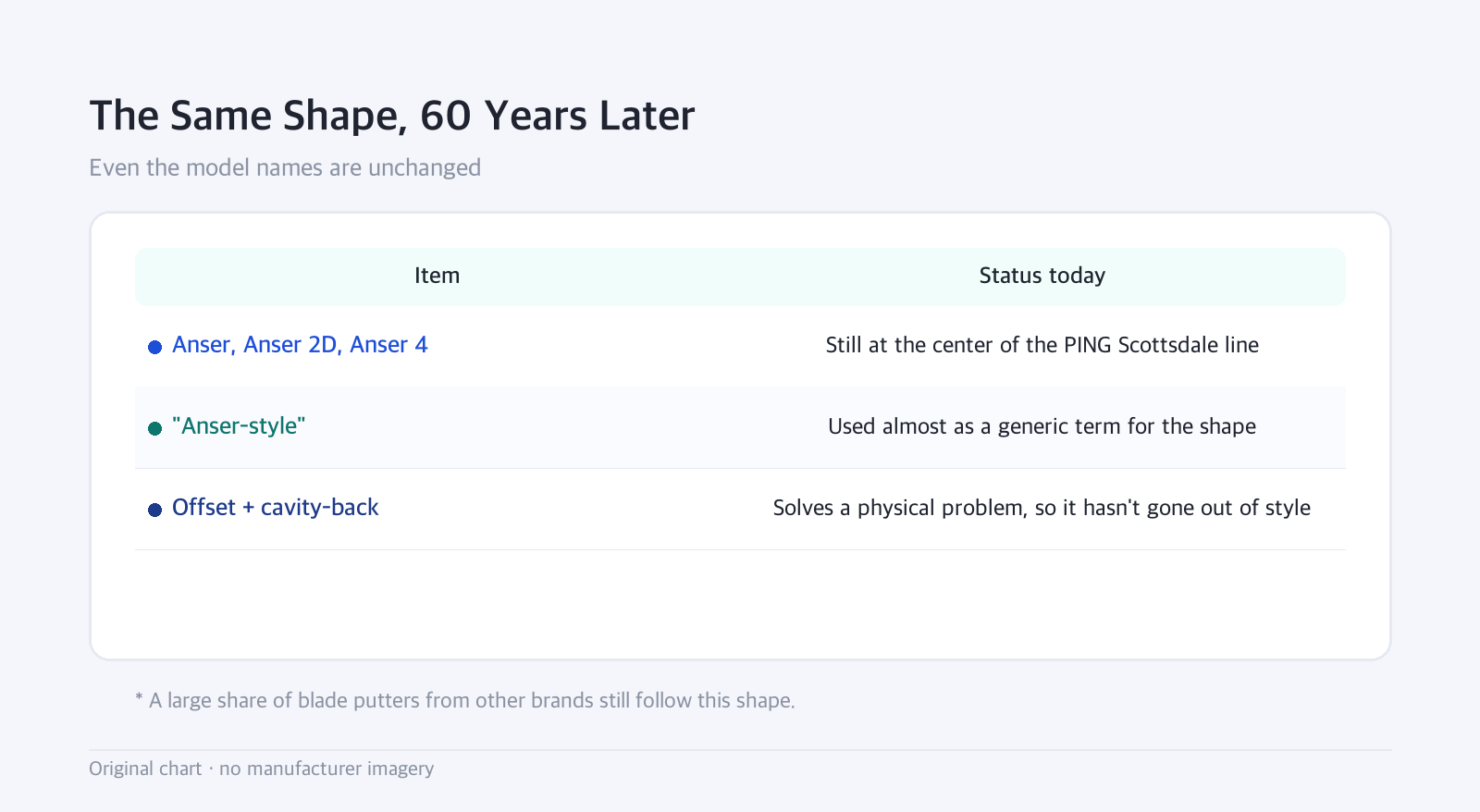
A sketch drawn on a record sleeve by one person has remained standard 60 years later.
The reason it survived is in the design itself. Offset and cavity-back solve physical problems, not a matter of taste. A visible face makes aiming easier; perimeter weighting reduces twisting. Neither goes out of fashion.
6. Who this is useful for
Based on what could be confirmed:
- Golfers who use a blade putter — the shape they use traces back to a 1966 sketch.
- Golfers curious why offset exists — it's a design solution for keeping the face visible.
- Golfers curious what cavity-back means — hollowing the back and sending weight to the heel and toe.
- Golfers looking at the PING Scottsdale line — the line names trace to a 60-year-old model.
This is less useful for:
- Golfers who use a mallet putter — the Anser belongs to the blade family.
- Golfers currently shopping for a putter — this is history, not a product comparison.
7. What we could not confirm
- The claims of the original patent text — we could confirm the patent number and dates only.
- The process between the sketch and the finished product.
- What happened to the original record sleeve — we could not confirm whether it survives.
- Early sales figures.
- The original source of the naming anecdote — it is preserved through Louise's own account, but we could not confirm a primary source.
- Exactly when the "Anser" name was first stamped on a product.
In one line
The Anser began with a sketch drawn on a 78-rpm record sleeve in January 1966.
The design used offset to keep the face visible, and cavity-back weighting to reduce twisting on off-center hits.
The name came from Karsten's wife, Louise — "Answer" with the w dropped, because the full word wouldn't fit on the toe of the putter.
Sixty years later, this shape remains the standard.
The years and patent details here are drawn from confirmed sources; anything we could not confirm is marked as such.
This piece summarizes general instruction concepts and is not personalized coaching advice. Ball flight fixes depend on individual swing mechanics — a launch monitor session or certified instructor can confirm what applies to you.