
There are several documented cases where the USGA and the R&A — golf's two rule-making bodies, which split jurisdiction between the U.S./Mexico and the rest of the world — moved on the same issue at different times: the 1910 Schenectady putter, the steel shaft in the 1920s, and the coefficient of restitution in 1998.
The 14-club limit had a time lag too.
We didn't know this while covering the other three cases — it turned up while researching this one. A fourth case.
1. Effective dates, 16 months apart
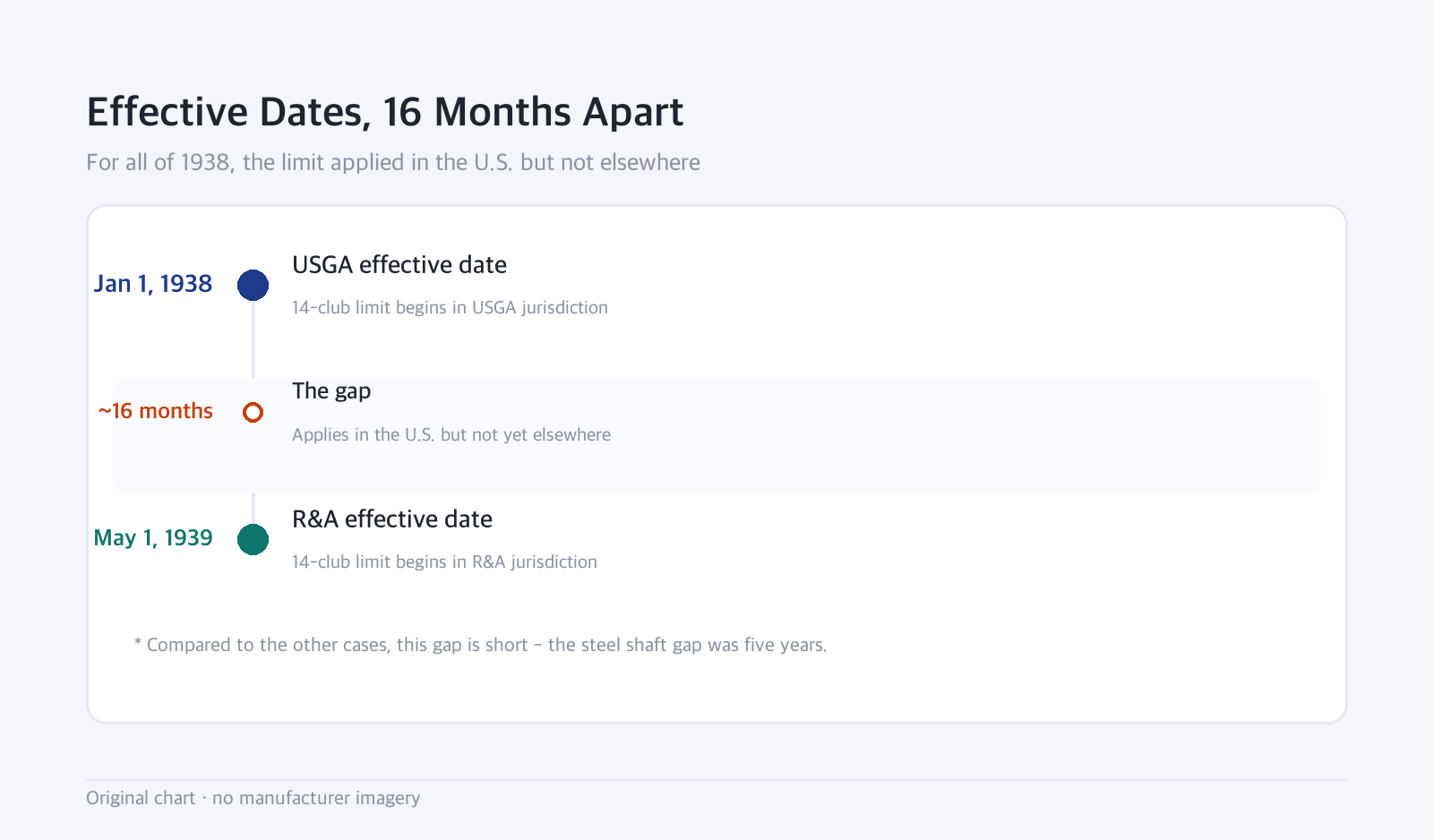
The confirmed effective dates:
- USGA — January 1, 1938
- R&A — May 1, 1939
A gap of roughly 16 months.
For all of 1938, the 14-club limit applied in the U.S. but not elsewhere.
Compared to the other cases, this gap is short. The steel shaft gap was five years; the coefficient-of-restitution gap took ten years to fully resolve. Still, the pattern of a gap existing at all is the same.
2. Four gaps, so far
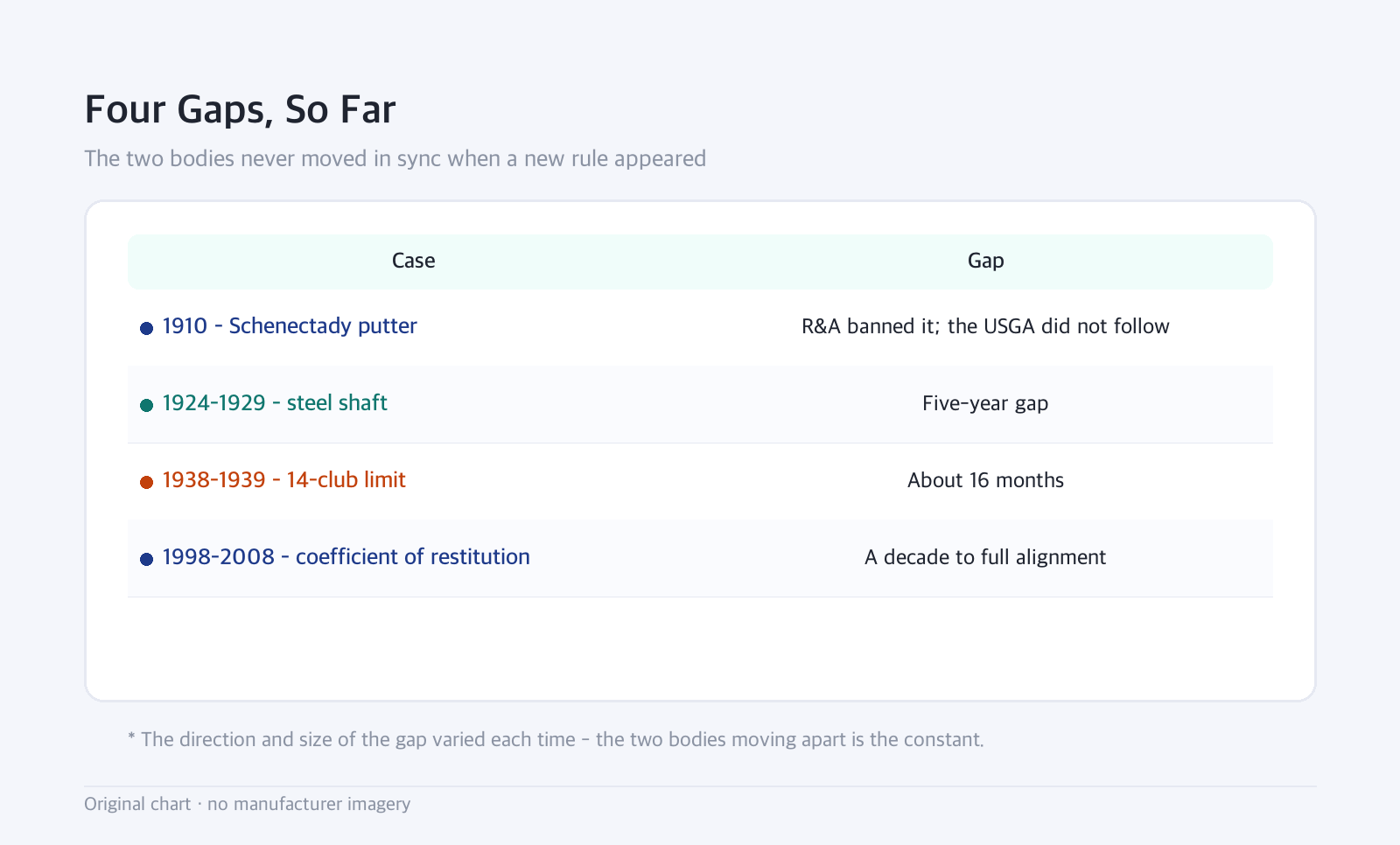
The confirmed cases so far:
- 1910 — the Schenectady putter. The R&A banned it; the USGA did not follow.
- 1924 and 1929 — the steel shaft. A five-year gap.
- 1938 and 1939 — the 14-club limit. About 16 months.
- 1998 and 2008 — the coefficient of restitution. A decade to full alignment.
The direction varied each time. With the Schenectady putter, the R&A restricted and the USGA allowed; in the other three, the USGA moved first.
The size of the gap varied too — from 16 months to a decade.
The one constant: the two bodies did not move in sync when a new rule appeared.
3. Why this kept happening
From here this is inference, marked as such.
The two bodies are separate organizations. Different jurisdictions, different decision processes. One deciding something doesn't mean the other automatically follows.
Communication was slow at the time. Coordinating across the Atlantic in 1938 meant letters or ship travel. A later example of this pace: a USGA delegation crossed to Britain in 1951 for 12 days of meetings to align the rulebooks.
And each side had its own circumstances — market conditions or member-club opinion may have differed.
This paragraph is inference, not confirmed fact.
4. Today is different
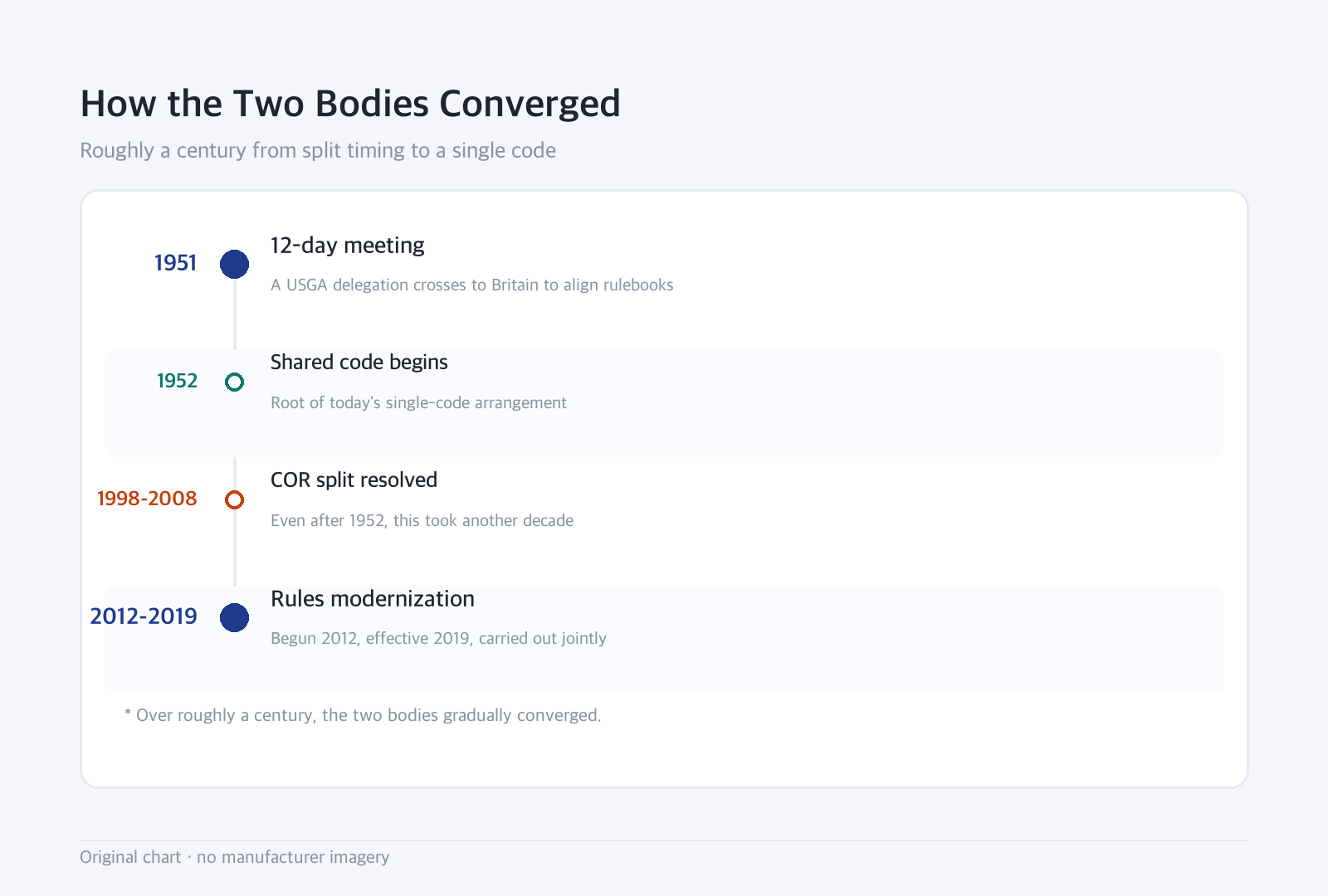
Today the two bodies run a single code. Jurisdiction is still split, but the rule content is the same.
The root of that arrangement is the 1951 meeting, twelve days that produced a shared code, effective from 1952.
Even after that, things weren't always smooth — the coefficient-of-restitution split in 1998 took another decade to resolve.
The most recent major joint project is the 2019 rules modernization — begun in 2012, effective seven years later, carried out jointly by both bodies.
Over roughly a century, the two bodies gradually converged.
Conditions today also make a gap less likely: equipment sells globally at the same time, and international competition runs year-round. A rule difference on one side becomes a problem almost immediately.
5. Where a rule arrives late
There's one more angle to the time-lag story: region.
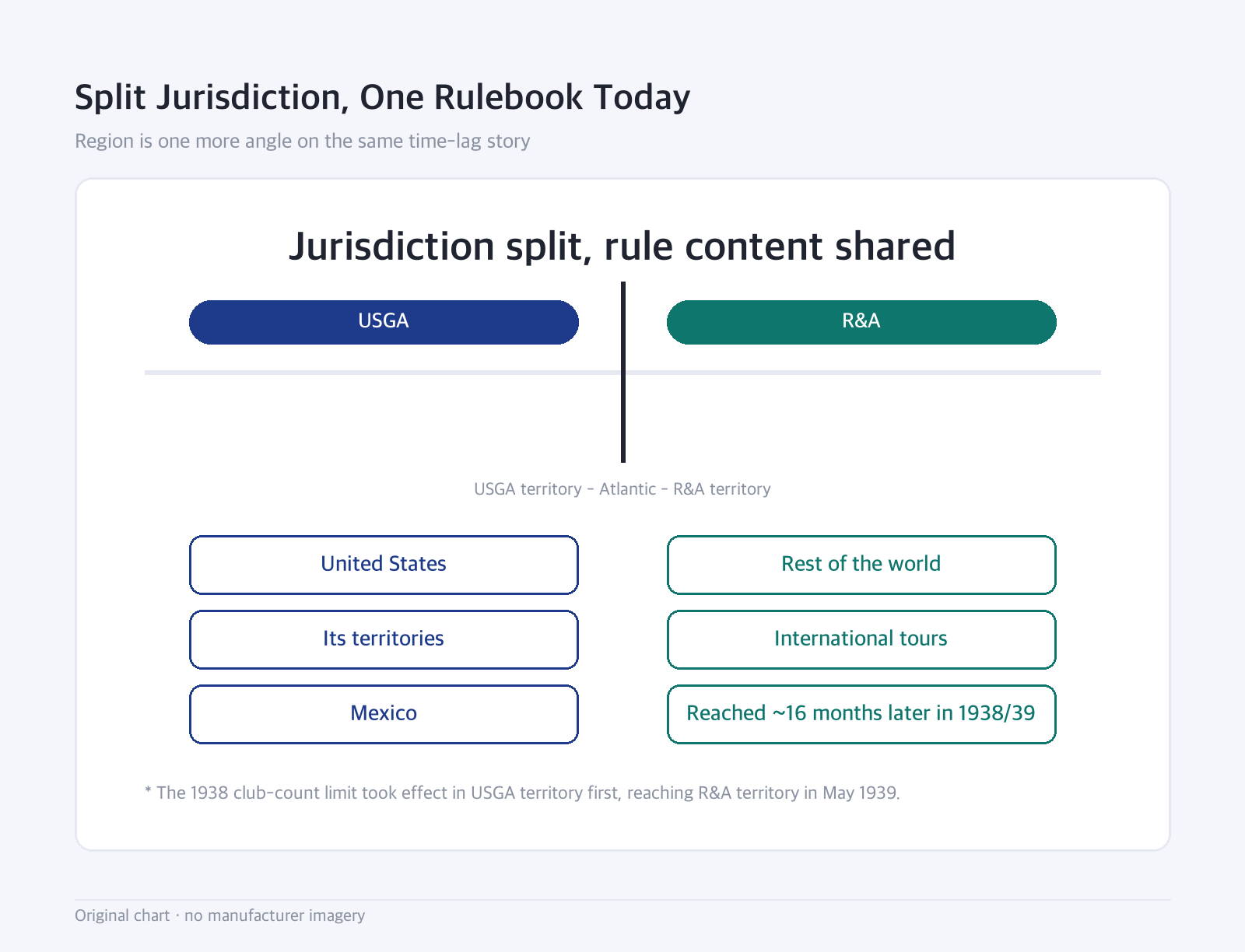
The jurisdictions split like this:
- USGA — the United States, its territories, and Mexico
- R&A — the rest of the world
The 1938 club-count limit, for example, took effect in USGA territory first and reached R&A territory roughly 16 months later, in May 1939. Exactly how that played out region by region at the time is something we could not confirm.
6. Who this is useful for
- Golfers interested in rules history — the two bodies have split on timing in at least four documented cases.
- Golfers reading older material — the same rule can have applied at different times depending on jurisdiction.
- Golfers curious about the relationship between the two bodies — today's single-code system took roughly a century to build.
- Golfers curious how governing-body jurisdiction is split — USGA covers the U.S. and Mexico; the R&A covers everywhere else.
Less useful for:
- Golfers who just need the current rule — the two bodies' standards match today.
- Golfers needing an on-course ruling — the jurisdictional split doesn't affect how a ruling is made.
7. What we could not confirm
- Why the R&A was 16 months behind — no documented reason found.
- How international events handled the gap during 1938.
- Records of coordination between the two bodies during this period.
- The gap between the 1936 adoption and the 1938/1939 effective dates.
- How the rule was actually applied region by region during the gap.
- Whether other timing gaps beyond these four exist.
In one line
The 14-club limit also had a timing gap between the two bodies: USGA effective January 1, 1938; R&A effective May 1, 1939 — about 16 months apart.
That brings the confirmed count of timing gaps to four: the 1910 putter, the 1920s shaft, the 1930s club-count limit, and the 1990s coefficient of restitution.
The direction and size varied each time, but the two bodies never moved in perfect sync.
Today they run a single code. It took a century to get there.
The dates here come from confirmed sources; inference is marked as inference.
This piece summarizes general instruction concepts and is not personalized coaching advice. Ball flight fixes depend on individual swing mechanics — a launch monitor session or certified instructor can confirm what applies to you.