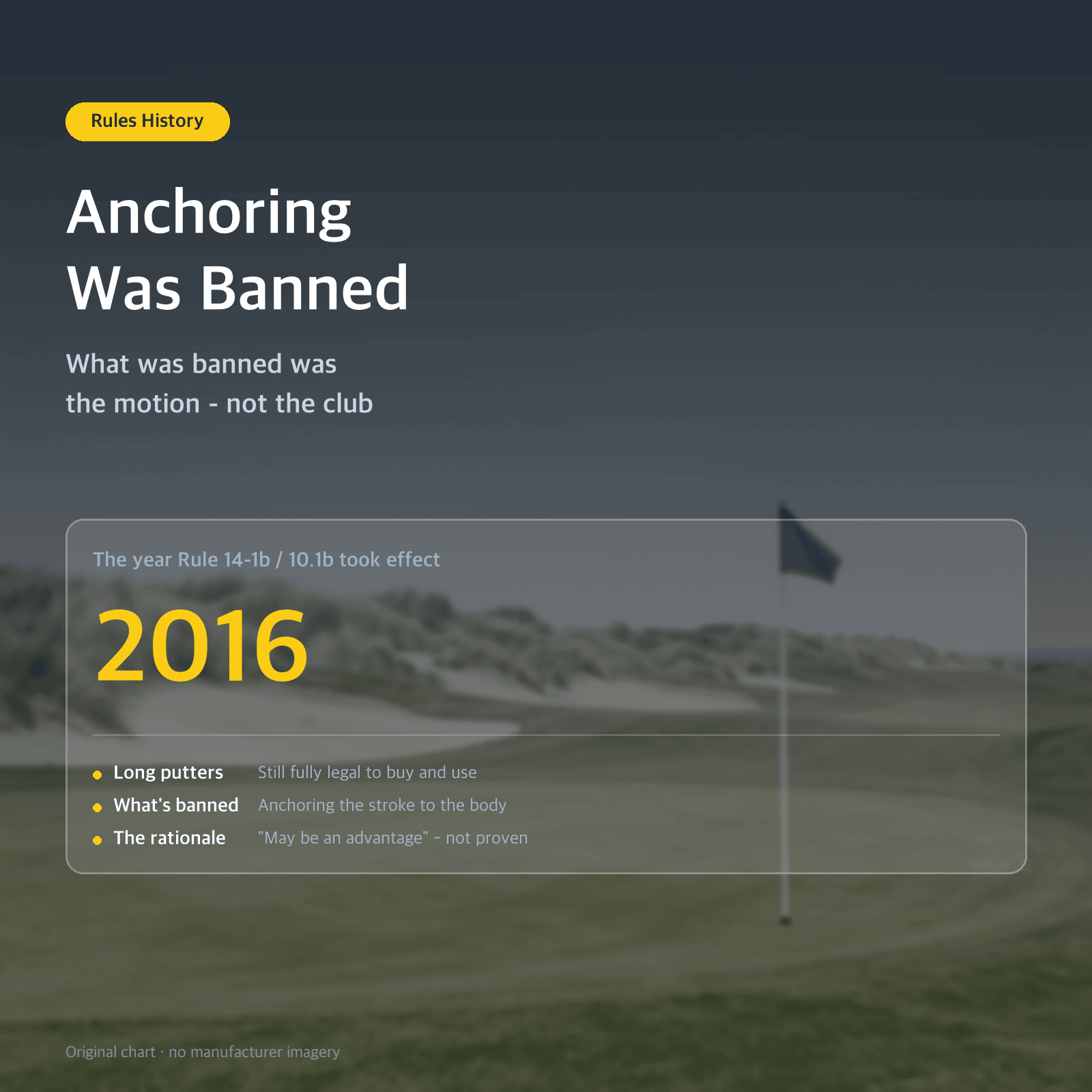
The most recent addition to golf's list of bans came in 2016. The target was anchoring.
There is a widely repeated misconception about this rule: that it is a "long putter ban." That is not accurate.
1. What was banned is a motion, not a club
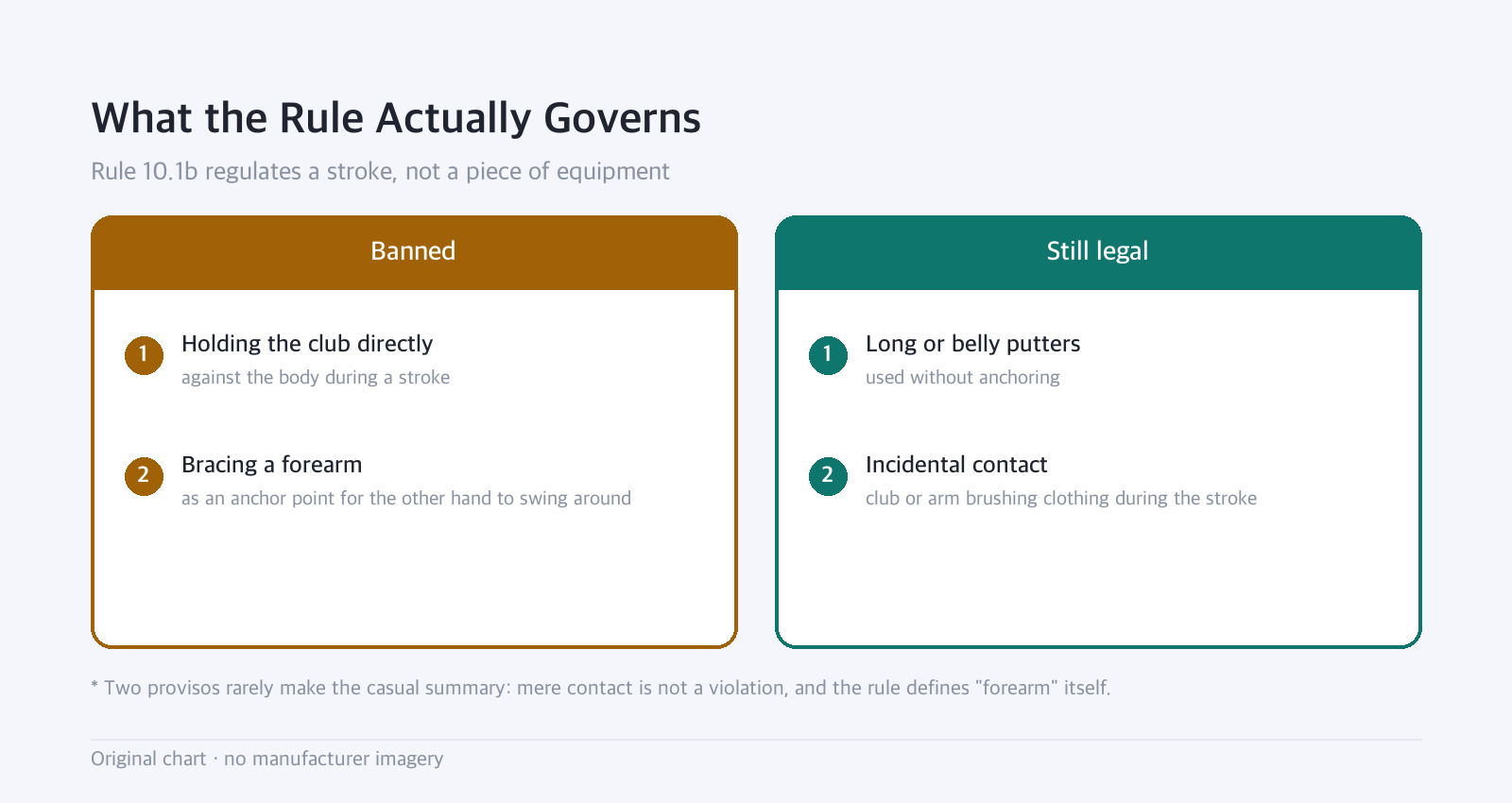
The rule's language is explicit. It governs the stroke, not the club.
Long putters and belly putters are still legal. There is nothing wrong with buying or using one. What is banned is making the stroke while anchoring that club against the body.
So a long putter swung without anchoring it to the body is fully compliant. Some players use them exactly this way.
2. What the rule text says
The current rule is 10.1b.
In making a stroke, the player must not anchor the club, either "directly" or by use of an "anchor point":
>
Directly — by holding the club or a gripping hand against any part of the body, other than the player's hand holding the club being held against another hand or forearm.
>
By Use of an "Anchor Point" — by holding a forearm against any part of the body to use that forearm as a stable point around which the other hand may swing or rotate the club with a gripping hand.
Two provisos attach to this, and they rarely make it into casual summaries.
First, mere contact is not a violation.
It is not a breach of this Rule for the club, either hand holding the club or a forearm to simply touch the player's body or clothing during the stroke, as long as this does not help the player stabilize the club or a gripping hand.
Second, the rule defines "forearm" itself.
For purposes of this Rule, a player's "forearm" refers to the part of the arm below the elbow joint and includes the wrist.
It is unusual for a rule to define its own terms this precisely. That alone suggests how much was at stake in disputed cases.
3. Major wins forced the issue
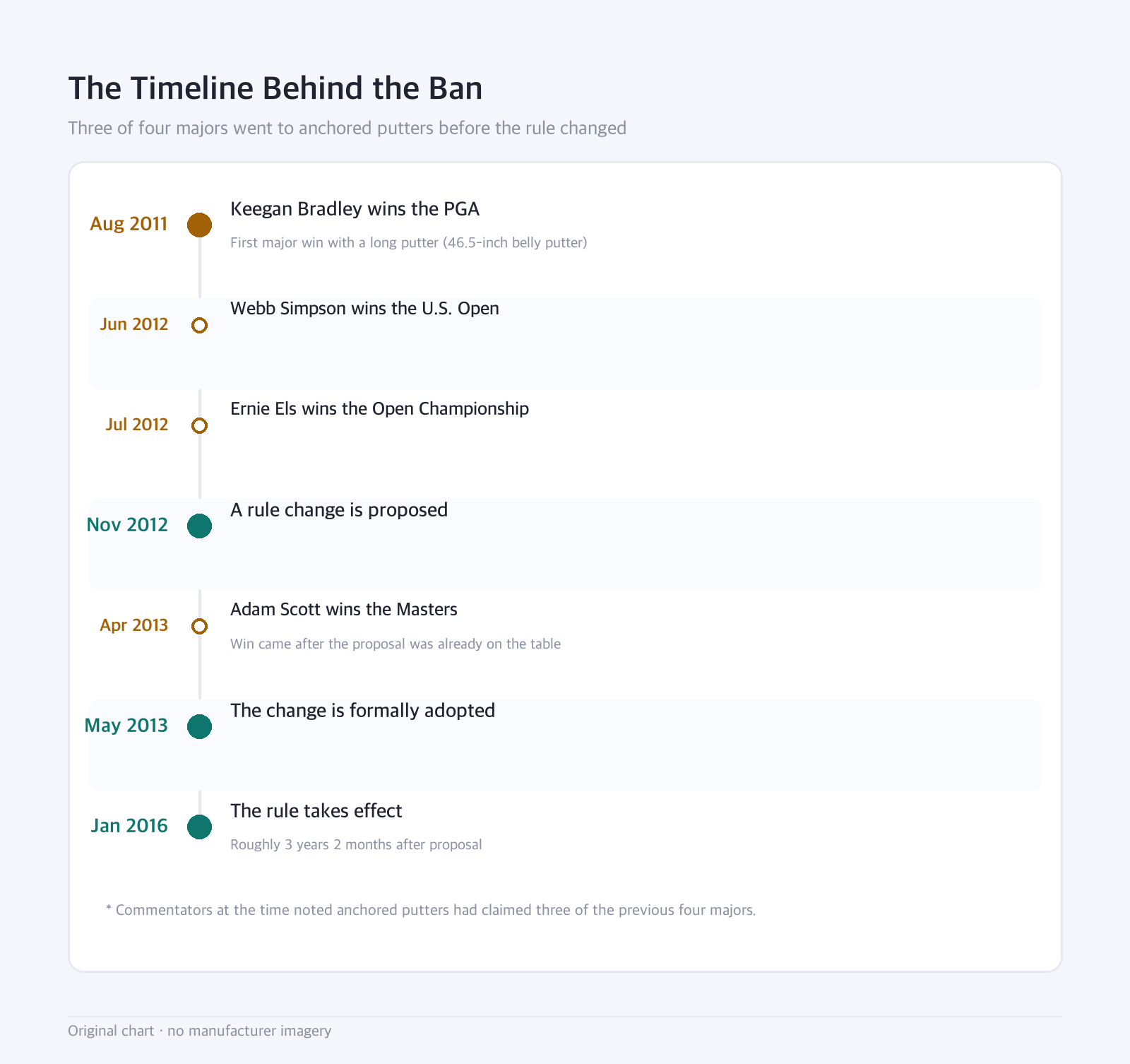
The timeline behind the ban:
- August 2011 — Keegan Bradley wins the PGA Championship using a 46.5-inch belly putter, becoming the first player to win a major with a long putter.
- June 2012 — Webb Simpson wins the U.S. Open.
- July 2012 — Ernie Els wins the Open Championship.
- November 2012 — a rule change is proposed.
- April 2013 — Adam Scott wins the Masters, a win that came after the proposal was already on the table.
- May 20, 2013 — the change is formally adopted.
- January 1, 2016 — the rule takes effect.
At the time, commentators noted that anchored putters had claimed three of the previous four majors.
Roughly three years and two months passed between proposal and effective date, reportedly to give golfers time to change their stroke.
4. This was a judgment call, not a proven fact
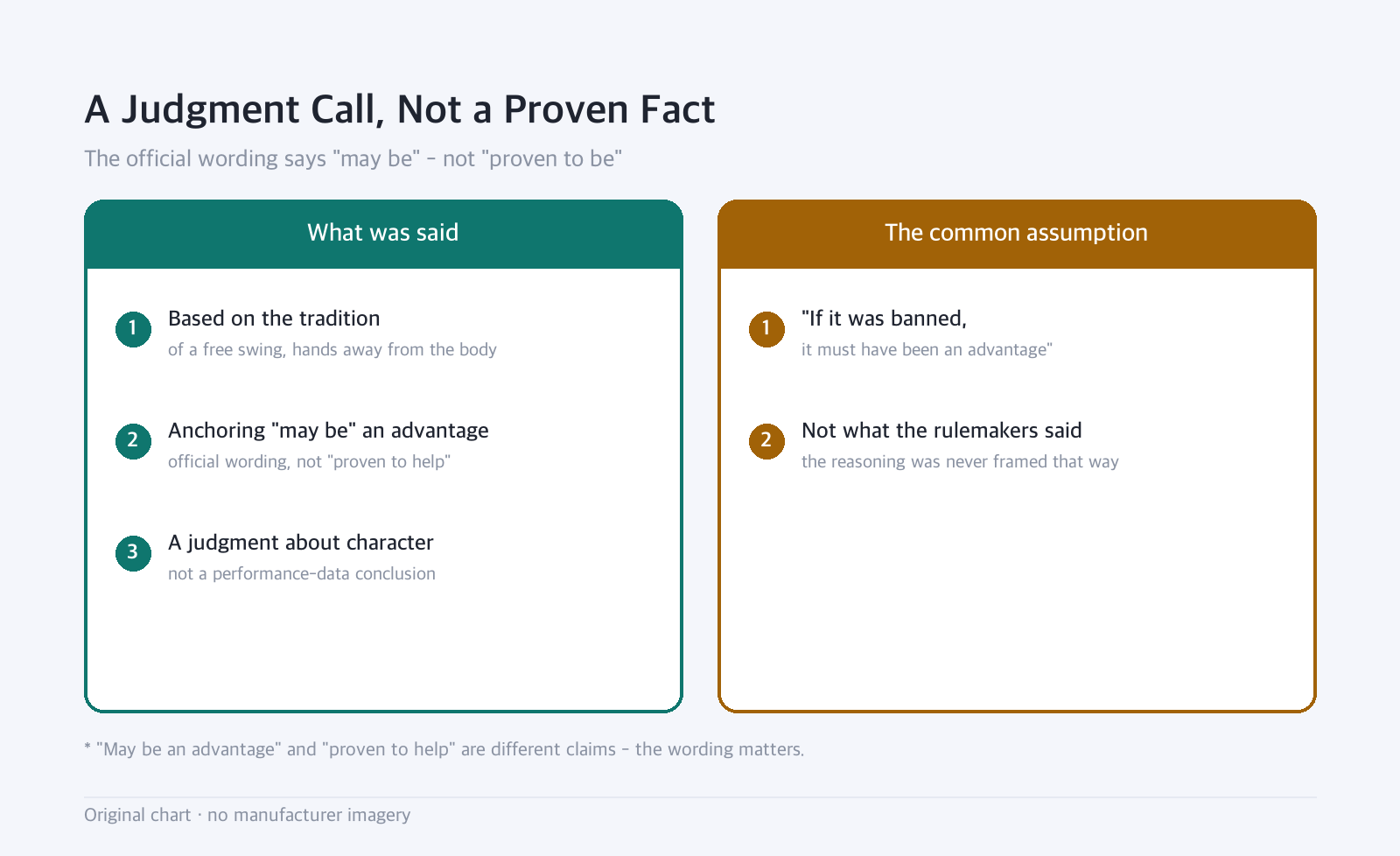
This is the part worth reading most carefully.
The stated rationale was the tradition of a free swing. A traditional stroke keeps the club and hands away from the body, with the player controlling the full motion of the club. Fixing one end of the club against the body creates a physical attachment point that departs from that tradition.
But the official explanation used a specific phrase.
This Rule is based on the belief that anchoring the club may be an advantage that reduces the challenge of making a stroke.
Not "proven to help" — "may be an advantage." The wording matters.
In other words, anchoring was not banned because performance data proved it was an advantage. It was a judgment about the character of the game.
The common reaction — "if it was banned, it must have been an advantage" — is not what the rulemakers actually said.
5. Penalty for violation
Standard penalties apply.
- Stroke play — two-stroke penalty
- Match play — loss of hole
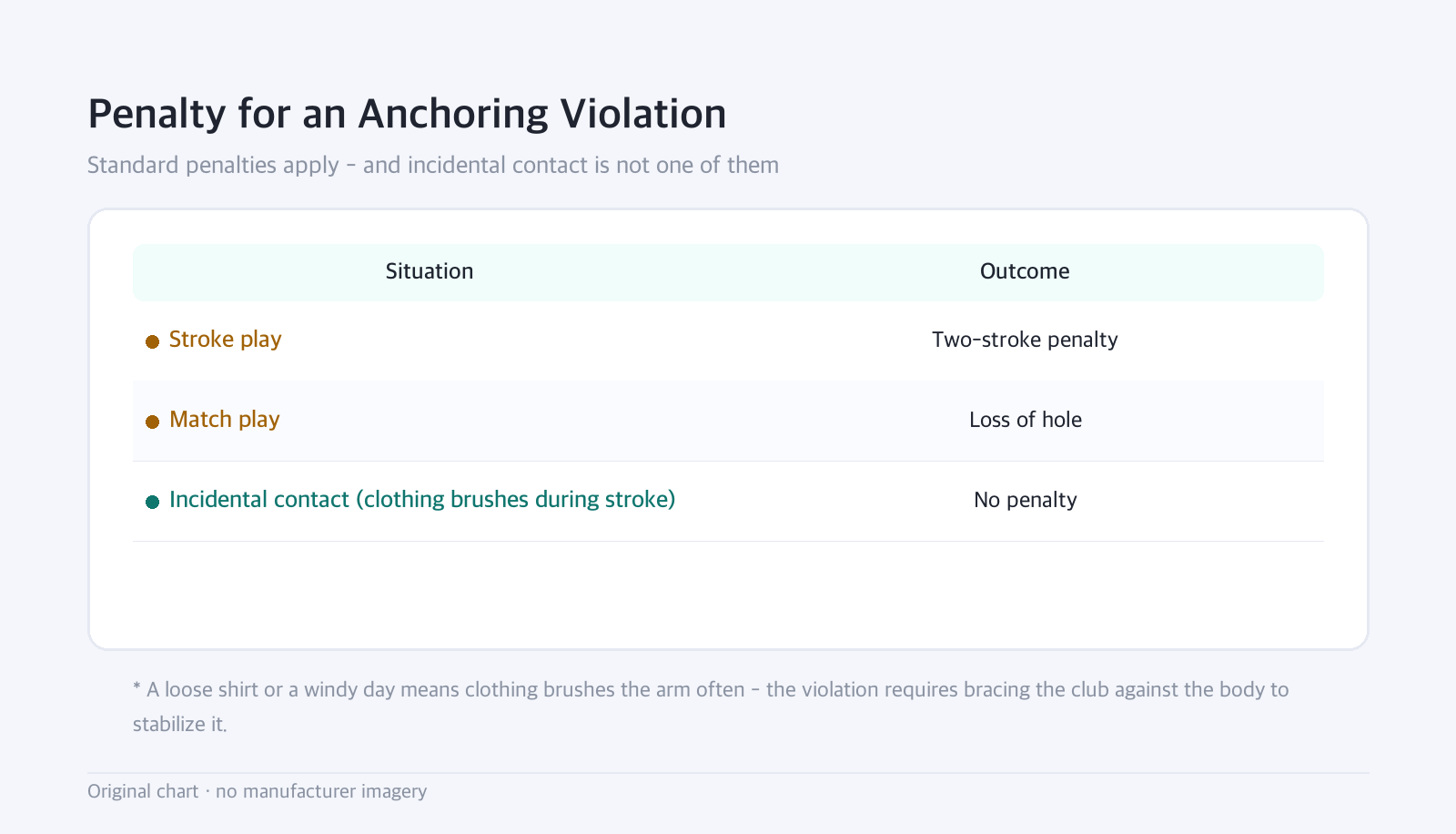
And as noted above, incidental contact carries no penalty. A club, hand, or forearm brushing against clothing during a stroke is not a problem by itself. The violation requires that it be held against the body to stabilize it.
This distinction matters in practice. A loose shirt or a windy day means clothing brushes against the arm often. Penalizing every such touch would make the rule unworkable.
6. Why there are two rule numbers
Searching this topic turns up both 14-1b and 10.1b. Both are correct.
- At the time the ban took effect in 2016 — Rule 14-1b
- Under the current rule set since 2019 — Rule 10.1b
The content is the same; only the numbering changed, because the entire rule book was renumbered in a 2019 overhaul.
Note also that "10.3b" circulates online and is incorrect. Rule 10.3 covers caddies.
7. Who this is useful for
Based on what could be confirmed:
- Golfers using or considering a long putter — the club itself is legal. Just don't anchor it to your body.
- Golfers worried their arm brushes their body while putting — incidental contact is not a violation.
- Golfers interested in arm-lock putting — bracing against the hand or forearm is an exception explicitly written into the rule.
- Golfers researching the rule — 14-1b and 10.1b are the same rule under two different numbers.
This is less useful for:
- Anyone who assumes "banned means it must have worked" — the rulemakers themselves said this was a judgment call, not proof.
- Casual round players — outside competition, this has no practical effect.
8. What we could not confirm
- The exact 2016 text of Rule 14-1b — we did not cross-check it word-for-word against the current 10.1b.
- The full course of opposition from the PGA Tour and PGA of America — we know opposition existed but could not trace the specifics.
- Any official ruling on arm-lock putting — it appears to fall under the written exception, but we found no separate official commentary confirming this.
- Long putter sales trends after the ban.
- The main counterarguments raised during the public comment period.
In one line
What was banned is the motion, not the club. Long putters and belly putters remain legal — you just can't anchor them to your body.
And mere contact is not a violation. Only bracing the club against the body to stabilize it is.
Above all, the rulemakers themselves described this as a judgment, not a proof. "If it's banned, it must have been an advantage" doesn't match what they actually said.
The rule text and dates here come from the official rules; anything we could not confirm is marked as such.
This piece summarizes general instruction concepts and is not personalized coaching advice. Ball flight fixes depend on individual swing mechanics — a launch monitor session or certified instructor can confirm what applies to you.