
The topics covered so far have been about the swing. This one turns to equipment — the adjustable hosel found on most modern drivers.
It has a property that's not widely known: adjusting loft moves face angle along with it.
1. Loft and face angle are linked
An adjustable hosel rotates a sleeve to change the angle at which the head attaches to the shaft. The markings are usually labeled by loft — plus one degree, minus one degree, and so on.
But on most modern hosels, this happens at the same time:
- Adding loft closes the face slightly — shifting toward a draw.
- Reducing loft opens the face slightly — shifting toward a fade.
It's not just loft that changes. Not knowing this leads to a common mistake: adjusting loft up "to raise ball flight" and ending up with more left misses.
And reducing loft also reduces spin. So when reducing loft to fight a left miss, both effects push in the same direction.
2. Can equipment fix a hook, then?
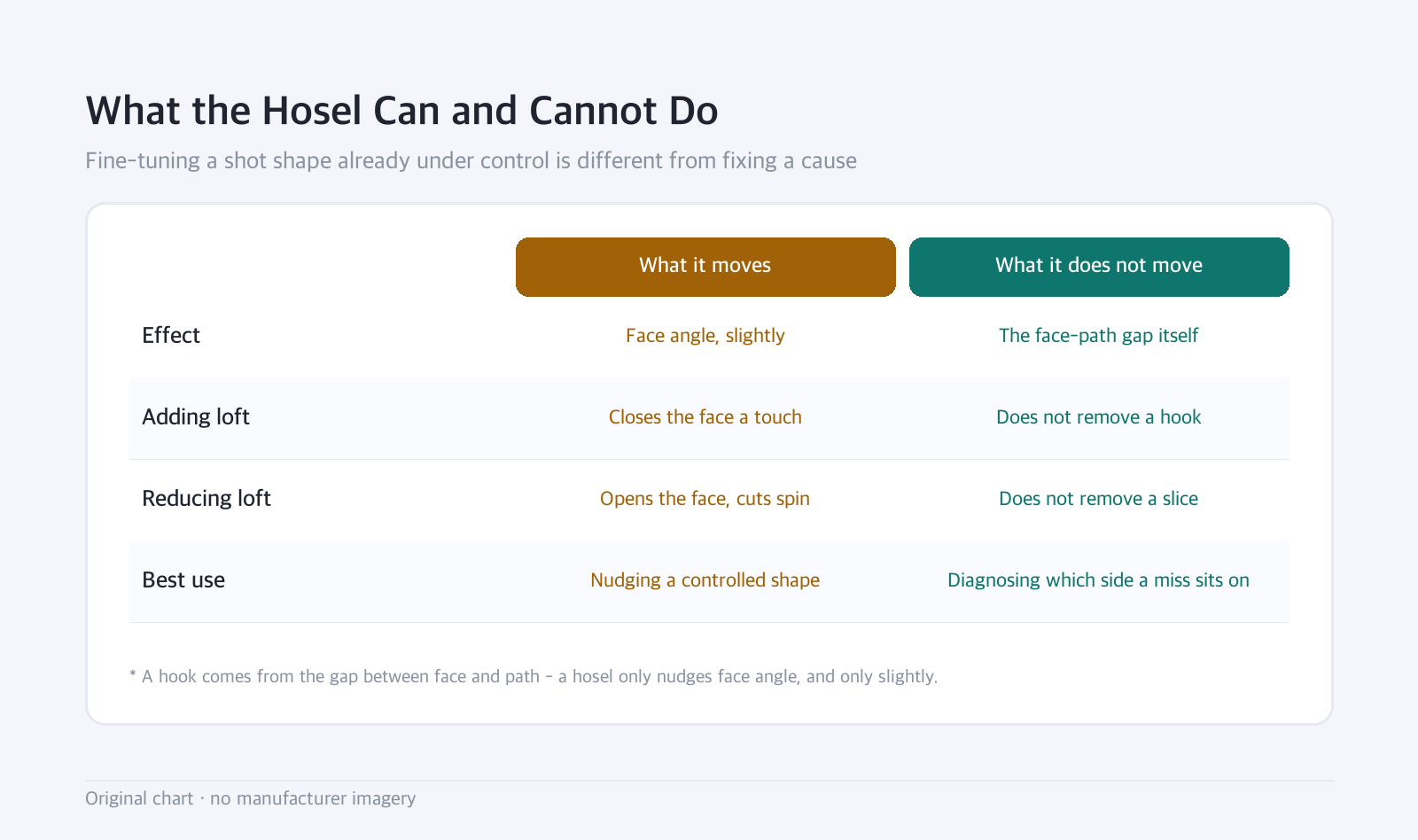
No. This is the most important sentence in this piece.
Loft adjustment alone doesn't fix a hook.
The reason follows directly from what's been established: a hook comes from the gap between face and path. What a hosel moves is face angle, and even that, only slightly.
So what is an adjustable hosel actually good for? Two things.
One, fine-tuning. It's for nudging a shot shape that's already under control — not a tool for removing a root cause.
Two, a diagnostic aid. Checking whether a left miss shrinks after reducing loft one step gives you a clue about whether the cause sits on the face side or elsewhere.
Nudging a symptom and removing a cause are different things — the same structure as adjusting your aim left, covered elsewhere.
3. A practical standard for using it
There's still a place to use it.
- Shot shape is consistent but slightly left → worth trying one step less loft. Just accept that ball flight will drop.
- Shot shape varies day to day → the hosel has nothing to offer. The cause is in the swing.
- Planning to add loft to raise ball flight → know that the face closes along with it.
- After making one adjustment → hit ten balls and log starting direction again. That's when you'll see whether anything actually changed.
That last point matters most. Change something without checking afterward, and you won't know what actually shifted.
4. What this series established
Six pieces, summarized together.
First, a draw and a hook are different boxes. They're separated not by how much the ball curves but by whether the face is under control, confirmed by starting direction.
Second, on the one fact-checkable claim we tested, the quote held up. Hogan's 1955 interview. Unlike three earlier cases with no backing, this one had a real source. You can't know which way it goes until you check.
Third, a hook reduces loft. It launches low with less spin, and its range of outcomes after landing widens. A slice costs distance but stays predictable.
Fourth, the common source of an amateur hook is over-correction. Every slice fix pushes leftward; push past the target, and you're on the other side.
Fifth, the snap hook is a different branch. It comes from a stalled body rotation forcing the hands to take over, and because it depends on timing, it appears suddenly.
Sixth, what equipment can move is fine-tuning, nothing more.
5. A pattern that kept repeating
Across this material, the same structure showed up again and again.
Cover up a symptom, and the cause keeps growing. That was true of aiming left to mask a slice, and it's true of misusing hosel adjustment too.
Diagnosis has to branch before the fix can. The slice split into four causes; the hook split into three boxes by starting direction.
Some widely repeated golf stories have no backing. Three didn't hold up. One did.
A quick fix and a correction are different things. Adjusting aim, easing swing intensity, adjusting the hosel — all three work in the moment, and none of them remove the underlying cause.
6. Who this is useful for
- Golfers using a driver with an adjustable hosel — loft isn't the only thing that changes.
- Golfers planning to add loft to raise ball flight — the face closes along with it.
- Golfers wondering whether equipment can fix a hook — only as fine-tuning.
- Golfers looking for a one-piece summary of this material — section 4 is that summary.
This is less useful for:
- Golfers using a driver without an adjustable hosel — the earlier pieces are the main content.
- Golfers who've already been fitted — if your settings are already dialed in, better not to adjust them casually.
7. What we could not confirm
- The actual face-angle change per manufacturer's hosel design — the direction of the effect is confirmed, but exact angle values aren't widely published.
- The real-world impact of a one-step loft change on shot shape.
- Performance differences between clubs with and without adjustable hosels.
- What share of amateurs actually improved their shot shape through hosel adjustment.
In one line
On an adjustable hosel, adding loft closes the face; reducing loft opens it. The label says loft, but two things move.
And loft adjustment alone doesn't fix a hook. What equipment can do is fine-tuning — nudging a symptom and removing a cause are different things.
A separate piece looks at the shank — the miss with the most different character in this material.
This piece summarizes general instruction concepts and is not personalized coaching advice. Ball flight fixes depend on individual swing mechanics — a launch monitor session or certified instructor can confirm what applies to you.