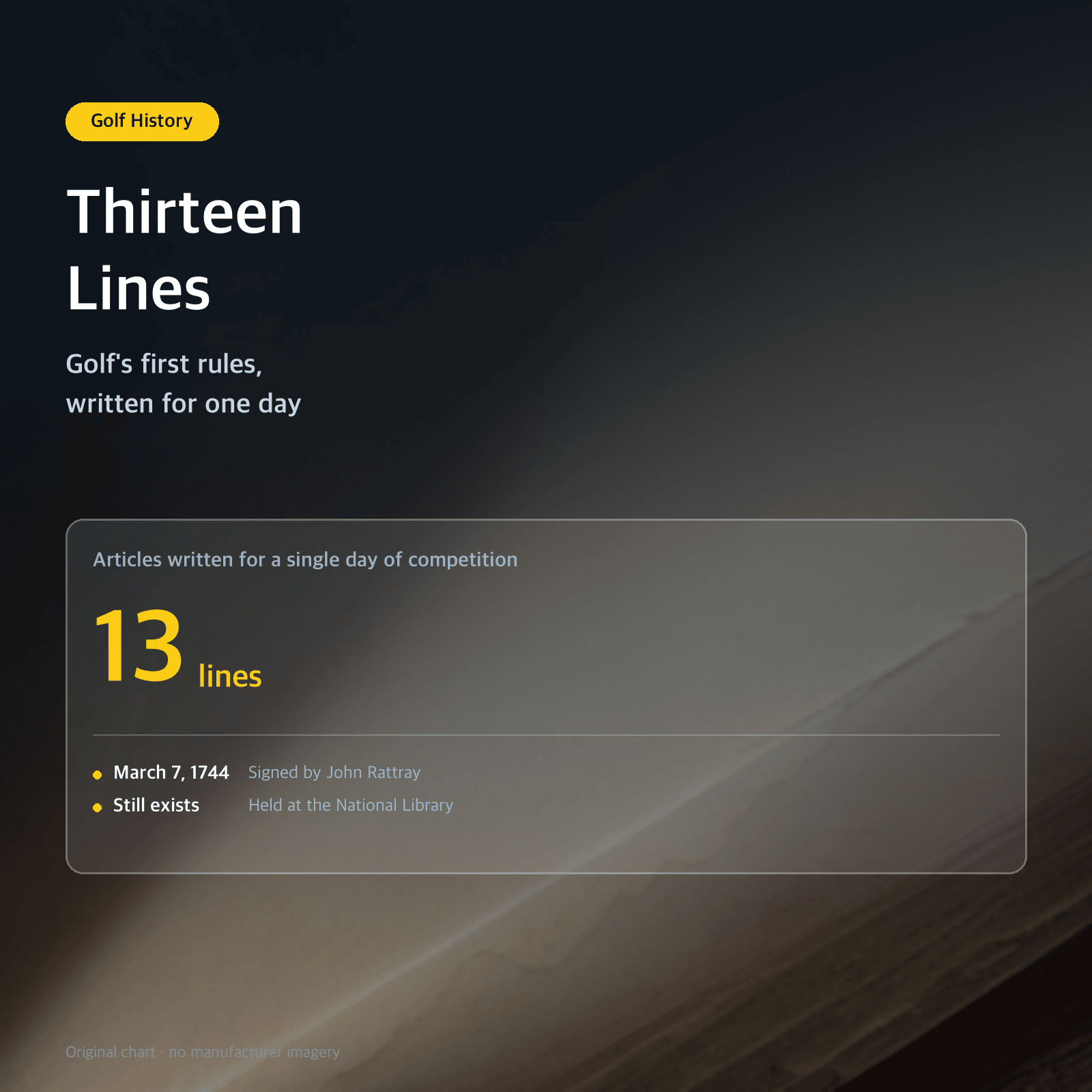
Golf's rulebook now runs to hundreds of pages, with commentary attached to individual rules and a separate case book functioning much like case law.
It started as thirteen lines.
And that document still exists today.
1. Written for a single day of competition
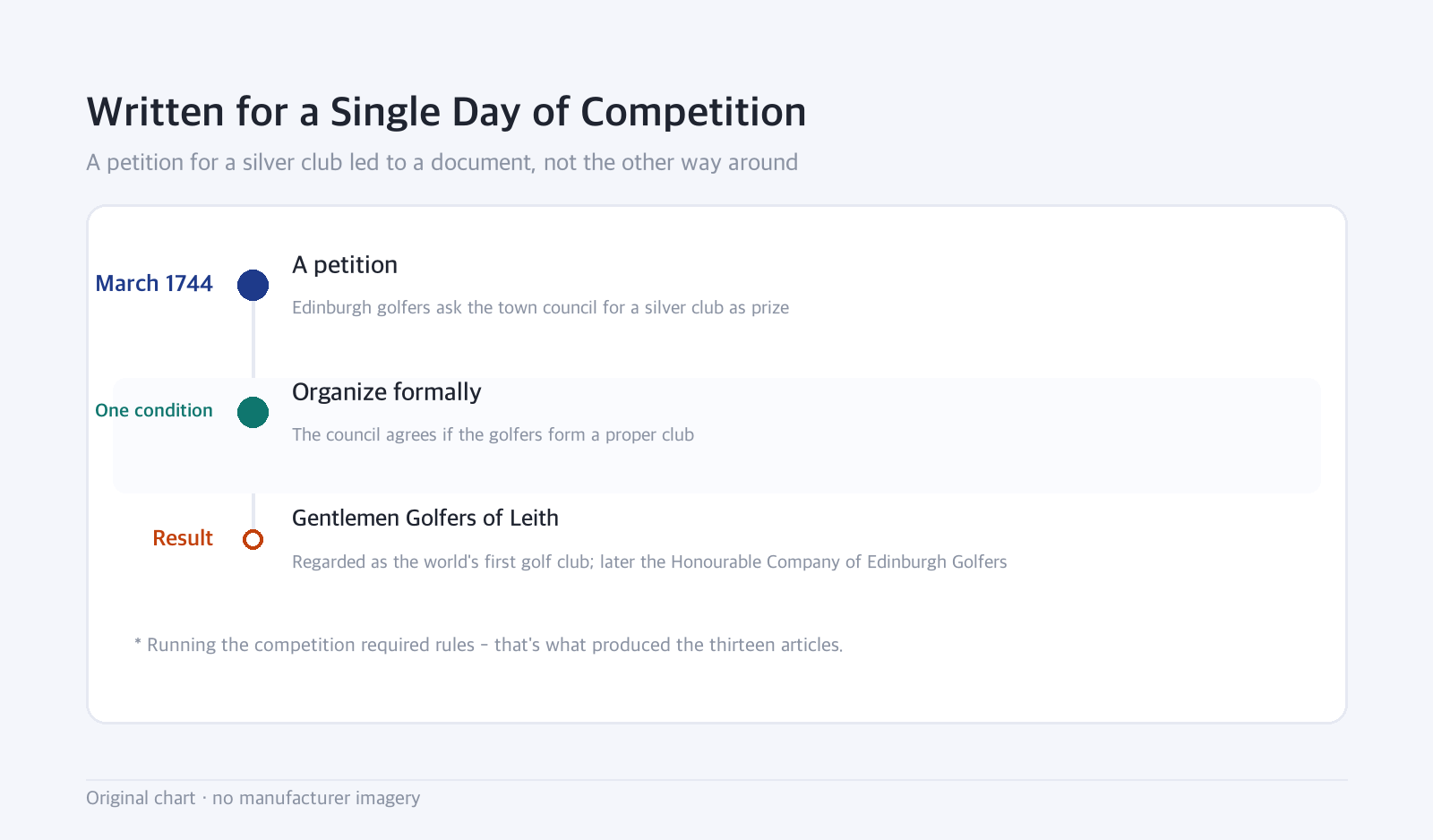
These rules weren't written to define golf. They were written because a competition had to be run.
In March 1744, golfers in Edinburgh petitioned the town council, asking for a silver club as the prize for a new annual competition.
The council agreed, on one condition: the golfers had to organize themselves formally.
That produced the Gentlemen Golfers of Leith, regarded as the world's first golf club — later renamed the Honourable Company of Edinburgh Golfers.
And running the competition required rules. That's what produced the thirteen articles.
2. The title and the signature
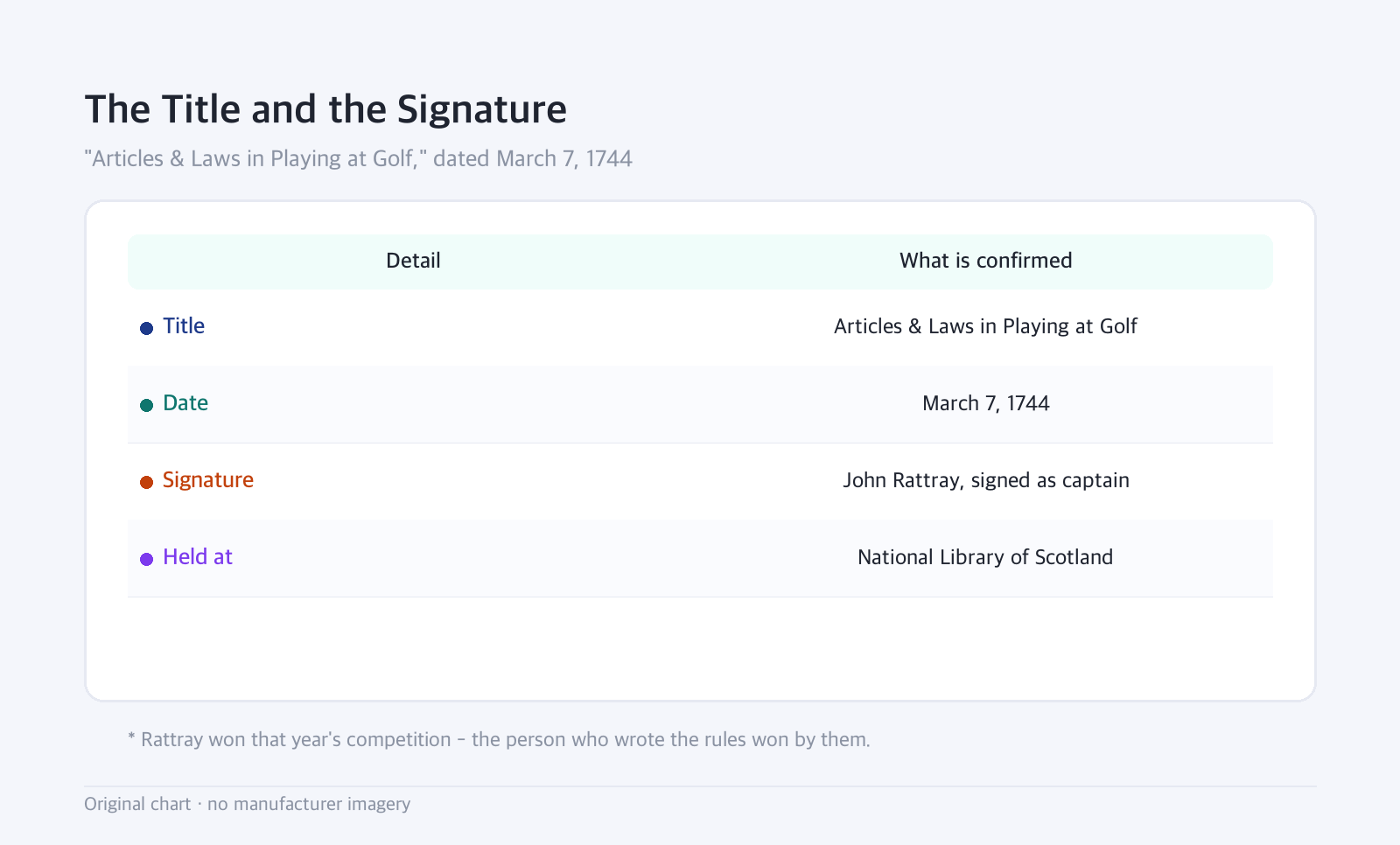
The document's formal title is "Articles & Laws in Playing at Golf."
It is dated March 7, 1744.
At the end of the document is a signature: John Rattray. He won that year's competition, and signed as captain.
The person who wrote the rules won the competition governed by them. That looks odd by today's standards, but at the time, club members were simultaneously the players and the administrators.
The document is held in the archives of the National Library of Scotland.
3. Why thirteen lines were enough
Compared to the current rulebook, the difference in length is enormous. A few reasons explain it.
It was written for a single day of competition. There was no need to cover every situation worldwide — only what might happen at one location, Leith Links, over the course of a single day.
Everyone playing knew each other. Disputes could be settled on the spot. There was less need to pre-specify every possible case in writing.
Equipment was simple. Few club types, one kind of ball. There was no need for equipment specification clauses like today's.
And, decisively, it was match play. The word "Adversary" appears repeatedly through the articles. Stroke play hadn't yet become standard, so the rules are framed around a contest between two people.
4. What happened afterward
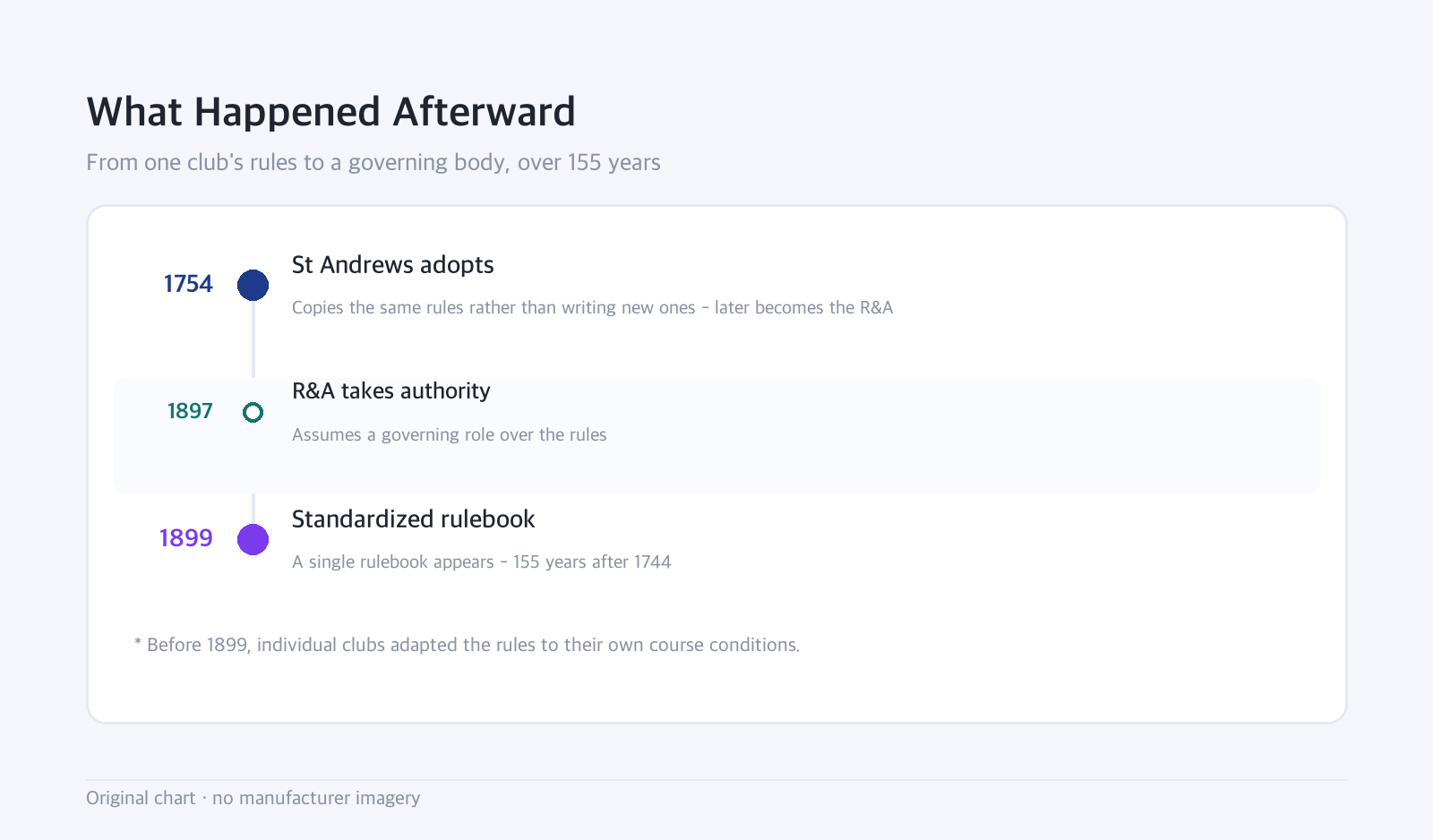
These thirteen articles weren't used only at Leith.
In 1754, St Andrews adopted these same rules — not writing new ones, but copying them over. That club later became the R&A.
A long period followed in which individual clubs adapted the rules to their own course conditions. A standardized rulebook did not appear until 1899, two years after the R&A took on governing authority.
In other words, from 1744 to 1899 — 155 years — what was in use was "broadly similar but different from course to course."
That looks inconvenient by today's standards, but at the time, traveling to play at a different course was rare. Small differences between courses weren't much of a problem. Standardization became necessary once people started traveling to play.
5. Still recognizable today
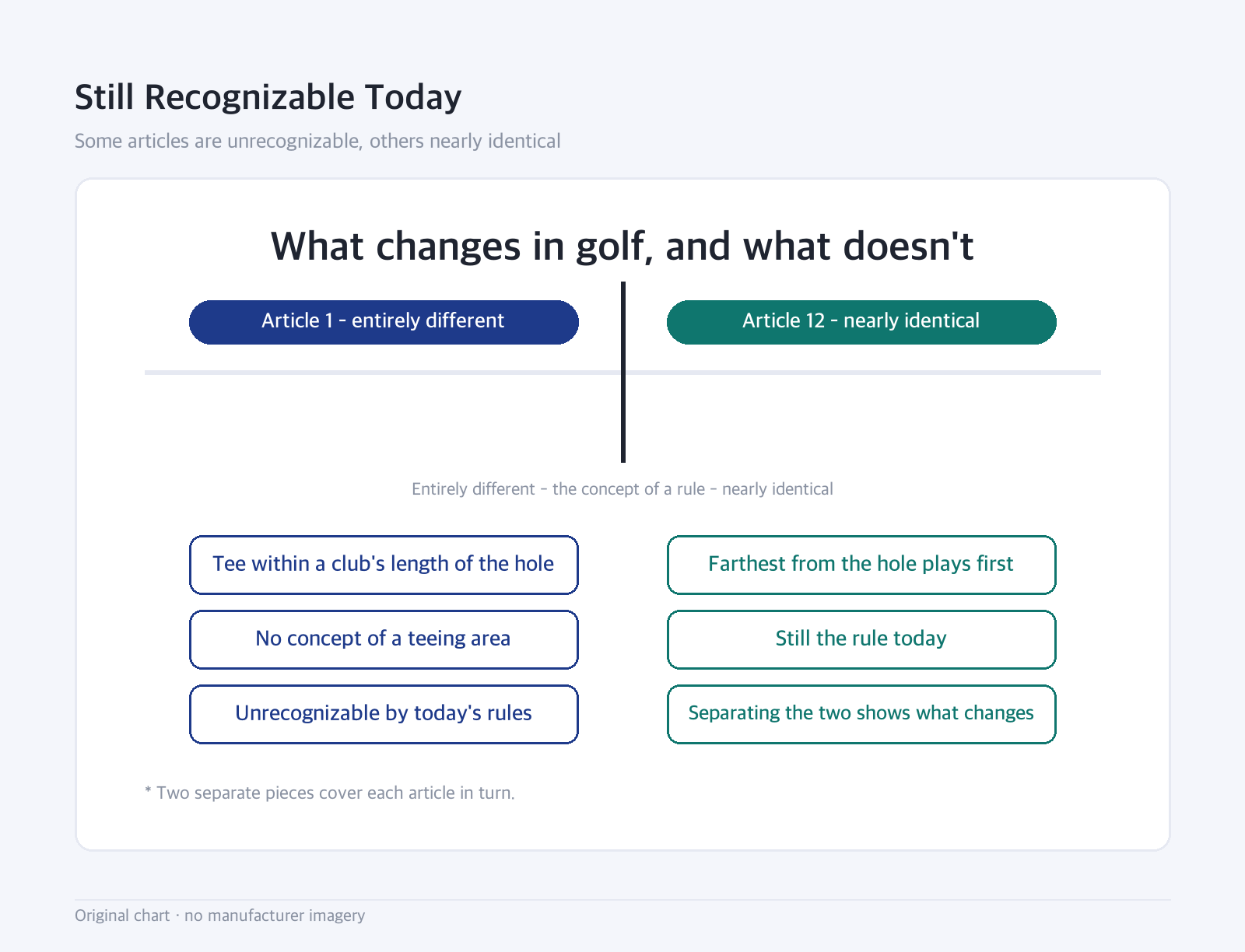
Among the thirteen articles, some are entirely unlike today's rules, and some are nearly identical.
As an example of the entirely different: Article 1 states that a player must tee the ball within one club's length of the hole. The concept of a teeing area didn't exist yet.
As an example of the nearly identical: Article 12 states that the player farthest from the hole plays first. That's still the rule today.
Whichever is more interesting is a matter of taste, but separating the two shows what changes in golf and what doesn't. Two separate pieces cover each in turn.
Note on the article numbers and phrasing above: these are drawn from the source material and have not been independently cross-checked word-for-word against a verified transcription of the 1744 original — flagged here for that reason.
6. Who this is useful for
Based on what could be confirmed:
- Golfers curious about the origins of the rules — this shows what the first written rules were made for.
- Golfers curious why the rules are so complicated now — the conditions that made thirteen lines sufficient no longer hold.
- Anyone planning a golf trip to Scotland — this lays out the relationship between Leith and St Andrews.
- Golfers who play a lot of match play — the original rules were built around match play.
This is less useful for:
- Golfers who need a ruling under the current rules — the 1744 articles have no force today.
- Anyone wanting the full text of every article — this piece covers the background; individual articles are covered in separate pieces.
7. What we could not confirm
- The physical condition and storage history of the document — we confirmed only that it is held at the National Library.
- Everyone involved in drafting it — beyond Rattray's signature, we could not confirm who else was involved.
- The number of participants and the format of the 1744 competition.
- What became of the silver club prize.
- Whether the rules were revised between 1744 and 1754.
- The layout of Leith Links at the time.
In one line
Golf's rules began with thirteen lines, written on March 7, 1744, to run a single day of competition. The document is titled "Articles & Laws in Playing at Golf," and John Rattray signed it as captain.
He won that year's competition. The person who wrote the rules won by them.
And that document still survives today, held at the National Library of Scotland.
The dates and history here come from confirmed sources; anything we could not confirm is marked as such.
This piece summarizes general instruction concepts and is not personalized coaching advice. Ball flight fixes depend on individual swing mechanics — a launch monitor session or certified instructor can confirm what applies to you.