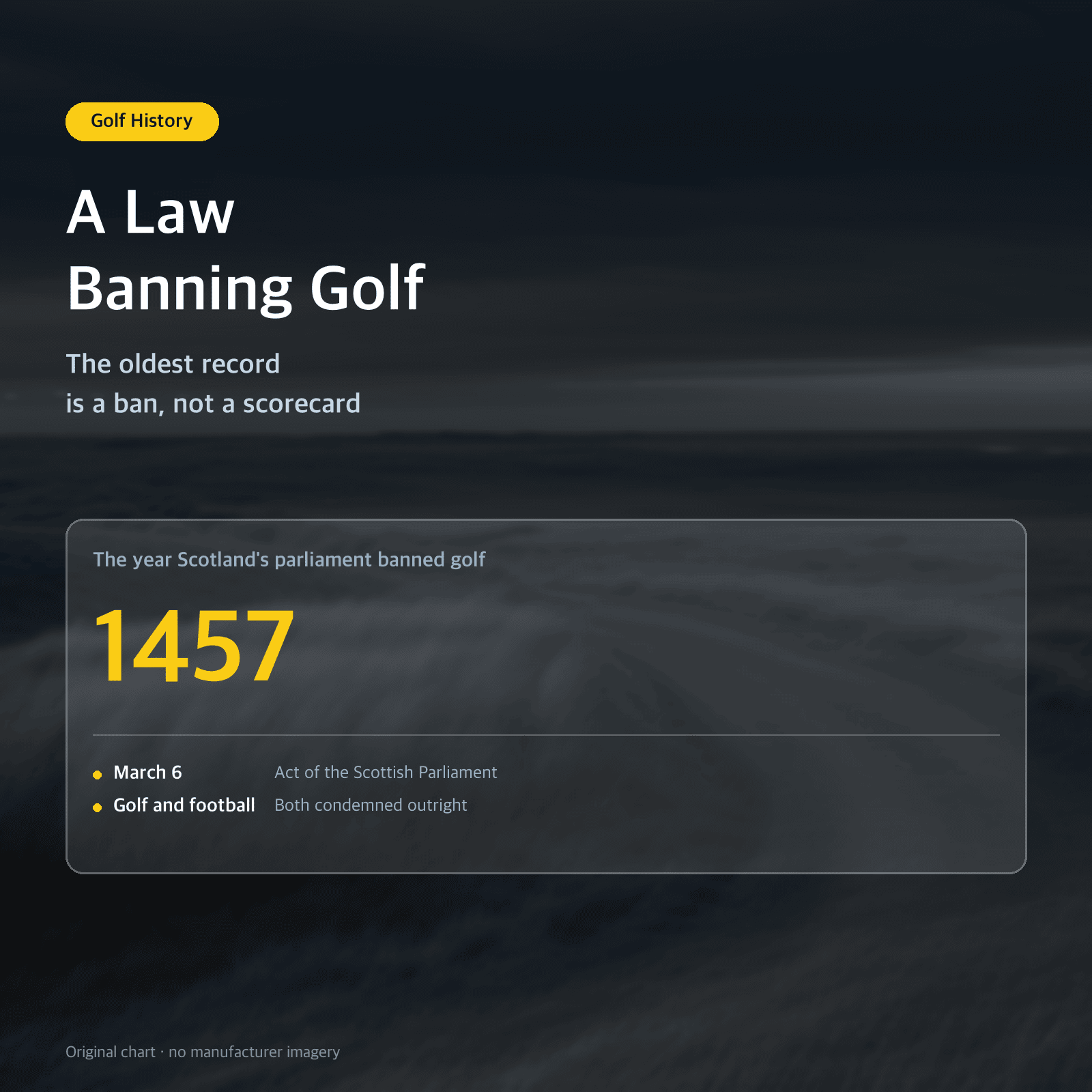
It's hard to pin down exactly when golf began. Play tends to come first, and records come later.
But the oldest document that mentions golf in Scotland is clear enough. And what it says is unexpected.
It's a law banning golf.
1. March 6, 1457 — an act of parliament
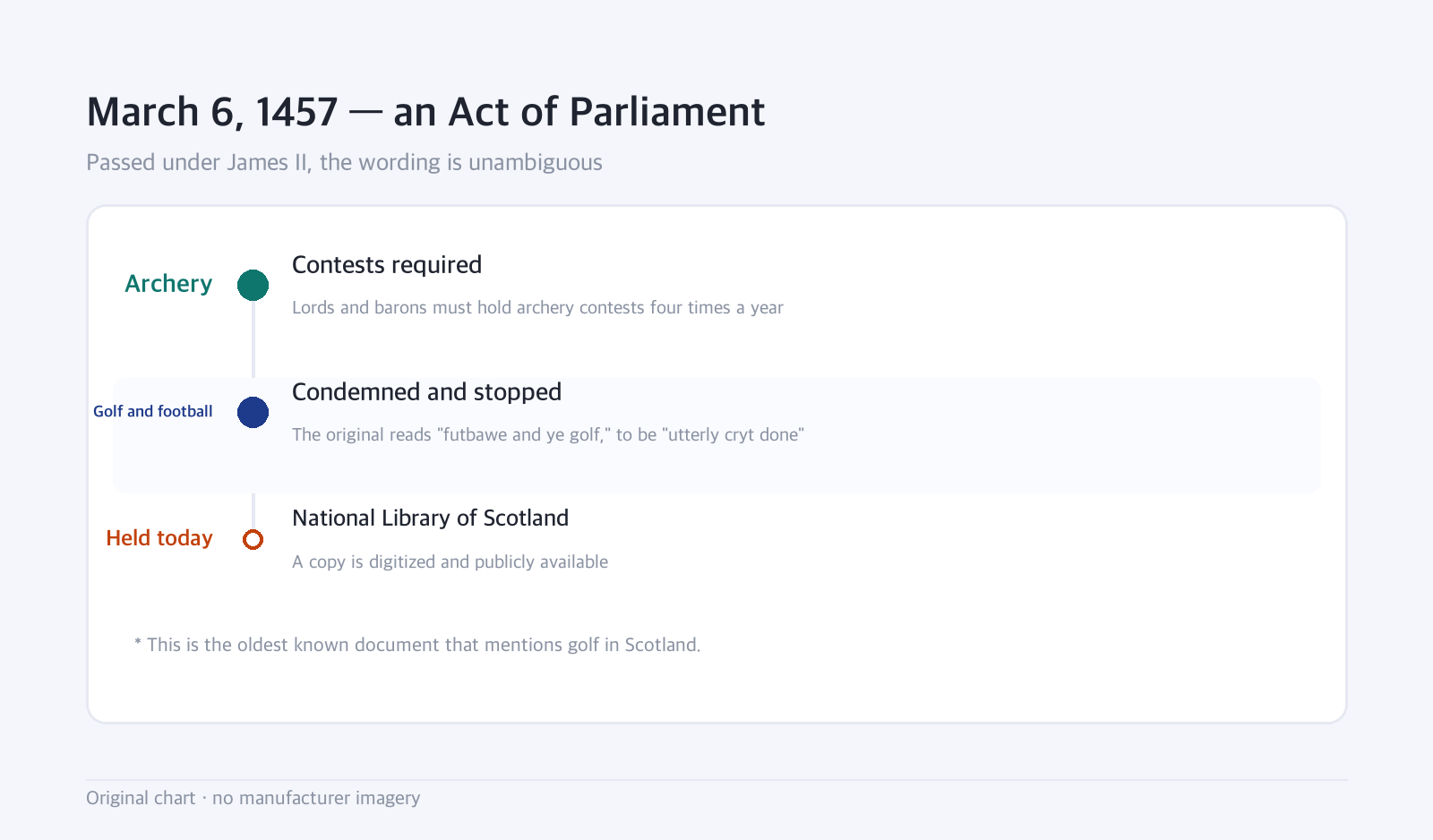
The Scottish Parliament, under James II, passed an act on March 6, 1457.
It said, in substance:
- Lords and barons should organize archery contests four times a year.
- Football and golf should be entirely condemned and stopped.
The original text reads "futbawe and ye golf," with an instruction to have them "utterly cryt done" — completely done away with.
A copy of this document is held by the National Library of Scotland and is digitized and publicly available.
2. Why it was banned — a matter of national defense
Why would a pastime be banned by law? The context of the time makes the reason clear.
Fifteenth-century Scotland had a weak crown and a strong nobility, and faced a constant threat of invasion. With no large standing army, the country needed a population it could mobilize when needed.
So every man over the age of twelve was required to train militarily, and the core of that training was archery. Archers were a decisive force on the battlefields of the time.
The problem: people were playing golf and football instead of practicing archery.
In other words, this law was not made out of dislike for sport. It was treated as a matter of national defense.
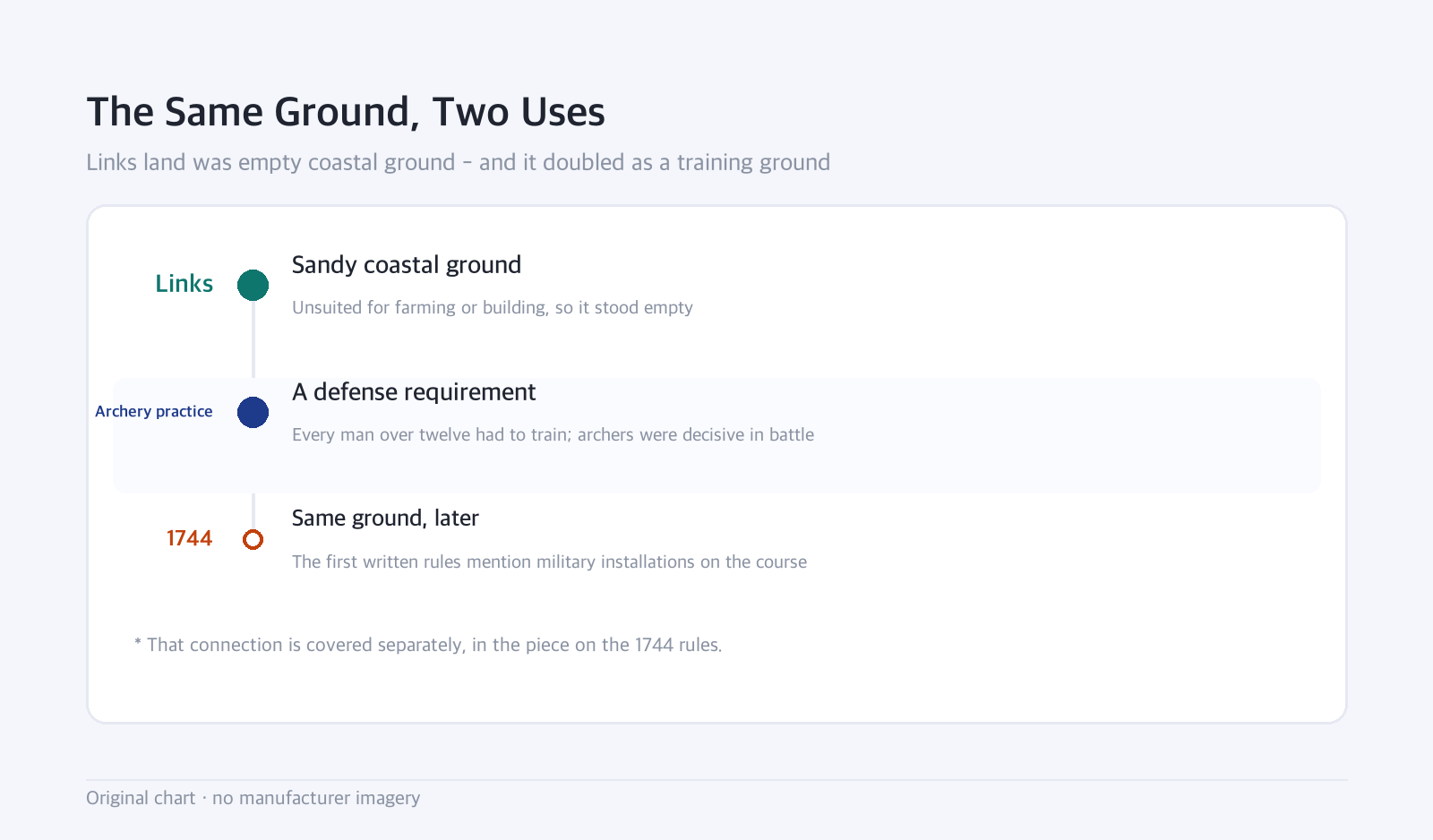
Archery skill doesn't build overnight. Drawing a longbow takes strength, and that strength only comes from repetition. That's why the law mandated contests four times a year — a scheduled contest forces practice.
Put the other way: golf was enjoyable without any practice at all. That was exactly the problem.
3. The ban itself became the record
There's an irony here.
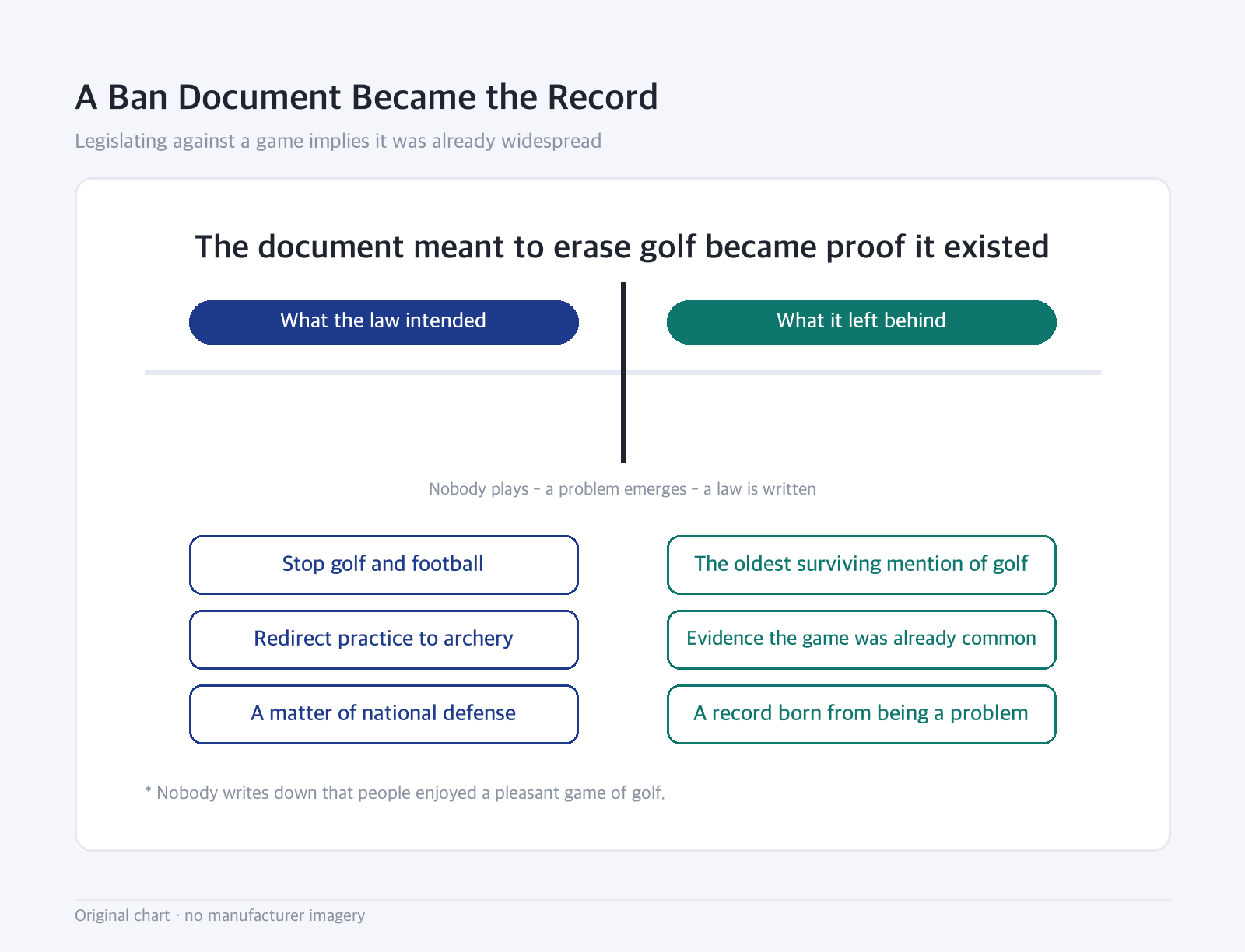
The document written to eliminate golf became the oldest surviving evidence that golf existed.
Banning something by law implies it was already widespread. No parliament bothers legislating against a game nobody plays. People were playing golf enough to threaten military training.
That's often how records survive. Nobody writes down that people enjoyed a pleasant game of golf. It's only when something becomes a problem that it gets documented.
A separate piece covers the first written rules from 1744, and the pattern is similar there too — that document wasn't created to record golf, but because a competition needed to be run. A document appears when there's a need.
4. And it wasn't followed
Whether this law actually worked can be seen in what came after.
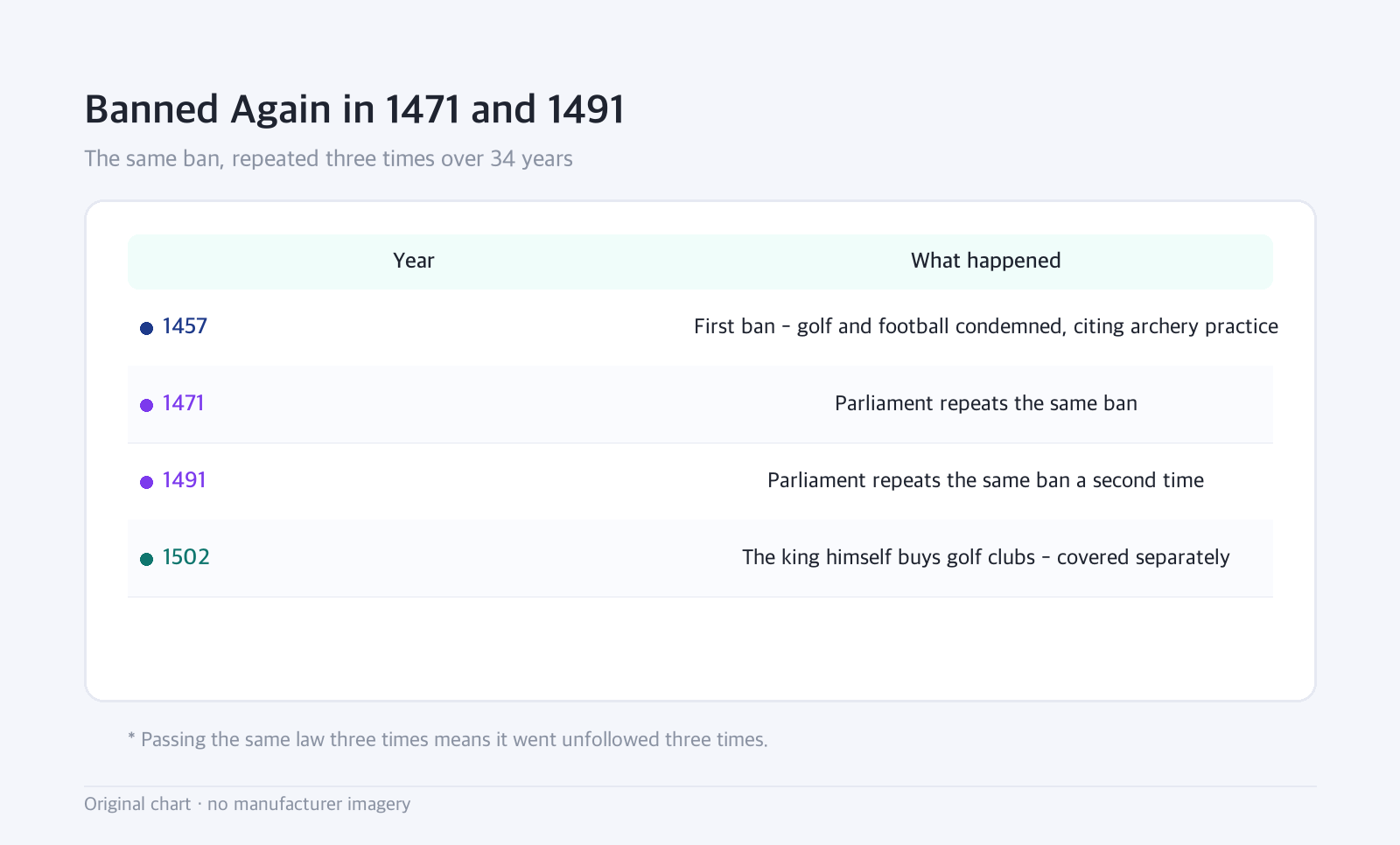
Parliament repeated the same ban in 1471, and again in 1491.
If a single ban had settled the matter, there would have been no reason to legislate it again. Passing the same law three times means it went unfollowed three times.
How that story ends is covered separately. In short: the crown eventually gave up.
5. What golf looked like at the time
Golf at the time looked quite different from today.
There were no maintained courses. Play happened on links — sandy coastal ground unsuited for farming or building, which is exactly why it stood empty and became a gathering place.
The same ground doubled as a military training ground. This turns up, unexpectedly, later — the first written rules, drawn up in 1744, mention "a soldier's trench." That story is covered in a separate piece.
In other words, the 1457 ban and the 1744 rules share the same backdrop of ground.
6. Who this is useful for
Based on what could be confirmed:
- Golfers curious about the origins of the game — the oldest documentary evidence is a ban, and the original copy is publicly available.
- Anyone planning a golf trip to Scotland — this explains why links courses sit on coastal sand in the first place.
- Anyone interested in golf history — this is a case study in how records survive at all: something has to become a problem first.
- Golfers curious about the history of the rules — this predates the first written rules of golf (1744) by 287 years.
This is less useful for:
- Golfers who only need the current rules — this piece is about origins.
- Anyone debating where golf originated more broadly — this piece covers only the Scottish record, not similar games elsewhere.
7. What we could not confirm
- A complete translation of the full act — we confirmed the key phrases, not the entire text.
- How the ban was enforced — penalties and actual enforcement, we could not confirm.
- The specific way golf was played at the time — how many holes, with what clubs, we could not confirm.
- Any record predating 1457.
- The etymology of the word "golf" — not covered here.
- Whether football was banned for the same reason.
In one line
On March 6, 1457, the Scottish Parliament banned golf and football, citing neglected archery practice — a matter of national defense.
And this document became the oldest surviving record that mentions golf in Scotland.
A law meant to erase the game became proof of its existence — evidence, in its own way, of how widespread it already was.
The dates and phrasing here come from confirmed sources; anything we could not confirm is marked as such.
This piece summarizes general instruction concepts and is not personalized coaching advice. Ball flight fixes depend on individual swing mechanics — a launch monitor session or certified instructor can confirm what applies to you.